Hagenbeck-Wallace Circus – Pageant of Persia (One Sheet Poster Portrait)

Hagenbeck-Wallace Circus – Pageant of Persia (One Sheet Poster Portrait)

LEASE ONLY

  • FRAMED

  • LINEN-BACKED

  • MUSEUM ACRYLIC

  • GUARANTEED ORIGINAL


Guaranteed Safe Checkout

Hagenbeck-Wallace Circus -Pageant of Persia C. 1934

(One Sheet Poster – Portrait)

History

The Hagenbeck-Wallace Circus, one of America’s premier tent shows in the early 20th century, originated from the 1907 merger of Benjamin Wallace’s Great Wallace Show (founded 1884 in Peru, Indiana) and Carl Hagenbeck’s Trained Animal Show, a European import emphasizing reward-based training for exotic beasts. At its zenith, it ranked second only to Ringling Bros. and Barnum & Bailey, touring 100+ U.S. cities seasonally via 45–48 rail cars, wintering in Peru, IN, with a “city” of 1,000 performers, 500 animals (including elephants, big cats, and camels), and 20+ tents seating 5,000–10,000. Tragedies marked its path: the 1913 Wabash flood drowned 8 elephants and 21 big cats, the 1918 Hammond train wreck killed 86 (yet the show endured with rivals’ aid), and it became a Ringling subsidiary in 1929, folding in 1938 amid Depression woes.

The “Pageant of Persia,” subtitled “The Glorious Origin of the Arabian Nights,” was a lavish opening spectacle (or “spec”) introduced around 1934 under the Hagenbeck-Wallace banner, evolving from earlier Orientalist pageants like Al. G. Barnes’ “Persia and the Pageant of Pekin” (1910s) and Barnum & Bailey’s “Persia, or the Pageants of the Thousand and One Nights” (1916). This 20–30-minute extravaganza opened performances with a procession of 100+ costumed performers (e.g., “veiled harem beauties,” “fierce Bedouin warriors,” turbaned sultans), camels, elephants in howdahs, and brass-band marches re-enacting Arabian Nights tales under the big top. It toured Midwest/South routes (e.g., Muncie, IN, 1932 analog “Cleopatra”), blending spectacle with the show’s menagerie to captivate Depression-era crowds seeking escapist opulence. The pageant underscored the circus’s resilience post-1929 acquisition, but ethical shadows (animal transport, performer hardships) loomed as it wound down by 1938.

Design

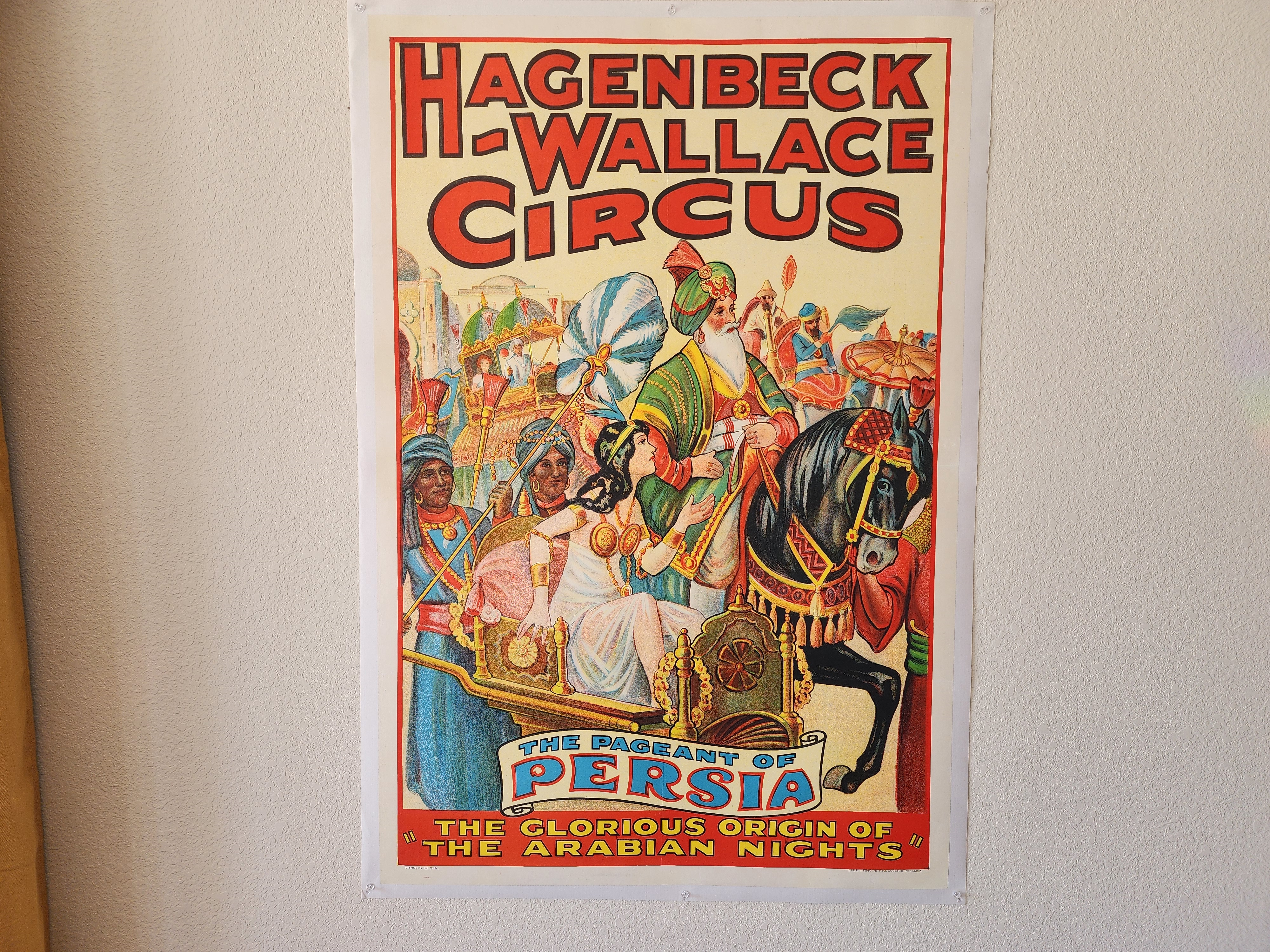
The “Pageant of Persia” poster, produced ca. 1934 by Erie Lithographing and Printing Co. (Erie, PA), epitomized Depression-era chromolithography’s ornate escapism, blending Gilded Age exuberance with streamlined affordability for barn postings. Typically a half-sheet (19½ x 28 inches) or one-sheet (up to 30 x 43½ inches) on heavy stock, it unfurled in jewel-toned primaries—vibrant crimsons and golds for silks and sunsets, deep indigos for night skies, earthy umbers for beasts—against a panoramic procession evoking a mythical caravan. Central vignettes depicted a white-bearded sultan enthroned amid comely courtesans in veils and jewels, flanked by turbaned attendants, rearing camels, and trumpeting elephants laden with howdahs, all marching toward a striped tent horizon in hyperbolic fantasy—spots exaggerated, fabrics rippling in implied wind.

Typography crowned the chaos with arched, ornate sans-serif headlines in 3–4-inch caps: “HAGENBECK-WALLACE CIRCUS PRESENTS THE PAGEANT OF PERSIA – THE GLORIOUS ORIGIN OF THE ARABIAN NIGHTS!” in gold-outlined crimson, trailed by script flourishes like “Majestic Procession of 1000 Wonders!” and a detachable lower banner for routes (e.g., “Lima, OH – May 17”). Echoing Strobridge Litho’s 1880s Orientalist templates (e.g., Aladdin motifs fused with Near/Far East chaos), the design layered cultural mashups—Persian rugs under Chinese lanterns—for visual punch, with fold lines, toning, and repaired tears signaling field wear. This lush, immersive style masked economic thrift, prioritizing allure to lure 50¢ ticket-buyers.

Cultural Significance

The “Pageant of Persia” poster crystallized American circus Orientalism—a gilded mirage of empire where Arabian Nights fantasies transported Dust Bowl audiences from breadlines to perfumed palaces, romanticizing “forbidden” Easts amid isolationism’s twilight. In 1934, as FDR’s New Deal reshaped heartlands, the imagery invoked aspirational excess: sultans as benevolent tycoons, veiled beauties as exotic femininity, beasts as tamed wilderness—reinforcing manifest destiny’s racial hierarchies (white rulers over “Moorish” throngs) while offering communal catharsis at fairs where immigrants and farmers mingled in awe. As vernacular propaganda, it perpetuated fused “Orientalism” (Persia meets Peking), influencing Hollywood epics (The Thief of Bagdad, 1940) and civic pageants, yet glossed exploitation—performers in blackface “Arabs,” animals in gilded chains—foreshadowing 1940s welfare critiques. Today, amid decolonial reckonings, it evokes bittersweet spectacle: a relic of big-top democracy critiqued for appropriation (#LandBack echoes), inspiring ethical revivals like Cirque du Soleil’s human-only fusions while fueling nostalgia in post-Ringling exhibits.

Production and the Company Behind It

The Hagenbeck-Wallace Circus Company, a proprietorship evolving into the American Circus Corporation (1919–1929 under Mugivan, Bowers, Ballard) before Ringling absorption, produced the pageant from Peru, IN, winter quarters (now Circus Hall of Fame site). The 1934 spec mobilized 100–200 cast (hired “Ethnological Congress” reenactors, equestrians like the Hannefords post-1918 wreck), 20+ camels/elephants in howdahs, and brass orchestras for 25-minute ring parades, integrated into 2-hour three-ring programs with 800 performers and 400 animals via 48 rail cars. Costumes (silks, turbans) sewn on-site, animals reward-trained per Hagenbeck legacy; budgets ($40,000–$60,000 seasonal) offset by 50¢–$1 tickets and concessions, with advance crews (2–4 weeks out) pasting 500–1,000 posters via wheat paste. Erie Litho printed runs of 300–600 using four-color stones for vibrancy; the pageant, directed by spec masters like those from Sells-Floto mergers, hyped menagerie ties, enduring as a Depression-era draw until 1938 closure.

Relevant Archival Sources and Modern Interest in Such Labels

Archival Sources:

  • The John and Mable Ringling Museum of Art (Sarasota, FL): eMuseum holds the “Hagenbeck-Wallace Circus Opening Spectacle ‘Persia'” photograph (1934, Edward J. Kelty, ht0005148) and analogs like Al. G. Barnes’ “Persia and the Pageant of Pekin”; searchable for spec designs and routes.
  • New York Public Library Billy Rose Theatre Division: Digital Collections archive the “Hagenbeck-Wallace Circus. Opening Spectacle ‘Persia'” (1934) and posters (e.g., 1907–1929 Bombayo aerialist variant); includes merger records and ephemera.
  • Library of Congress Prints & Photographs Division (Washington, DC): Circus Poster Collection features early Hagenbeck-Wallace lithos (1900–1910, Otis Litho, POS – CIRCUS – Hagenbeck Wallace no. 1); folklife holdings on Orientalist specs.
  • National Fairground & Circus Archive (University of Sheffield, UK): Circus Friends Association Collection preserves U.S. programs/posters (1920s–1930s), including Hagenbeck-Wallace specs; digitized for international tours.
Dimensions 28 × 42 in
Framed

Black

Linen Mounted Selection

Yes

Reviews

There are no reviews yet.

Be the first to review “Hagenbeck-Wallace Circus – Pageant of Persia (One Sheet Poster Portrait)”

Your email address will not be published. Required fields are marked *

Shopping Cart
Scroll to Top