Barney O’Hern Circus – Dog & Pony Act
History
The Barney O’Hern Circus, formally Barney O’Hern’s World Wide Circus, was a short-lived postwar American tent show that operated exclusively during the 1946 season, emerging amid a national craving for communal, affordable escapism as the United States demobilized from World War II. Founded by Barney O’Hern, a seasoned showman with a background in vaudeville, carnival concessions, and sideshow operations for larger circuses like Hagenbeck-Wallace, the venture was a compact one-ring operation tailored for rural and small-town audiences in the Midwest and Northeast. O’Hern, active in the industry since the 1920s, curated a modest ensemble of equestrians, wire walkers, clowns, showgirls, and trained animal acts, including a signature “Dog & Pony Act” featuring leaping dogs and prancing ponies trained for tricks like hurdle jumps, barrel rolls, and synchronized marches. The dog and pony routines, a staple of Depression-era “dog and pony shows,” were performed by a troupe of 6–8 mixed-breed dogs (often rescues or farm strays) and Shetland ponies, handled by O’Hern family members or hired trainers, emphasizing whimsy over grandeur to appeal to children and families.
The circus toured approximately 40–50 dates across states such as Ohio, Pennsylvania, New York, and Illinois, partnering with county fairs, VFW halls, and open lots under a secondhand big top seating 800–1,000. The “Dog & Pony Act” poster variant promoted this act as a crowd-pleasing highlight, customized for stops like the Butler County Fair or Erie, PA., engagements, where the 10–15-minute segment opened or closed the 90-minute program. Postwar realities—echoing fuel rationing, labor shortages from returning veterans, equipment breakdowns, and nascent competition from radio broadcasts—hastened its closure; O’Hern auctioned assets to cover debts and reverted to carnival work, etching the show as a quintessential “one-season wonder” in the lore of independent “mud shows.”
Design
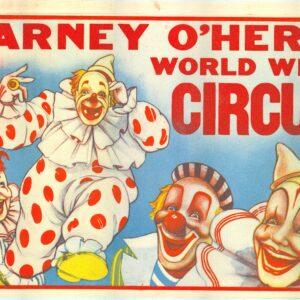
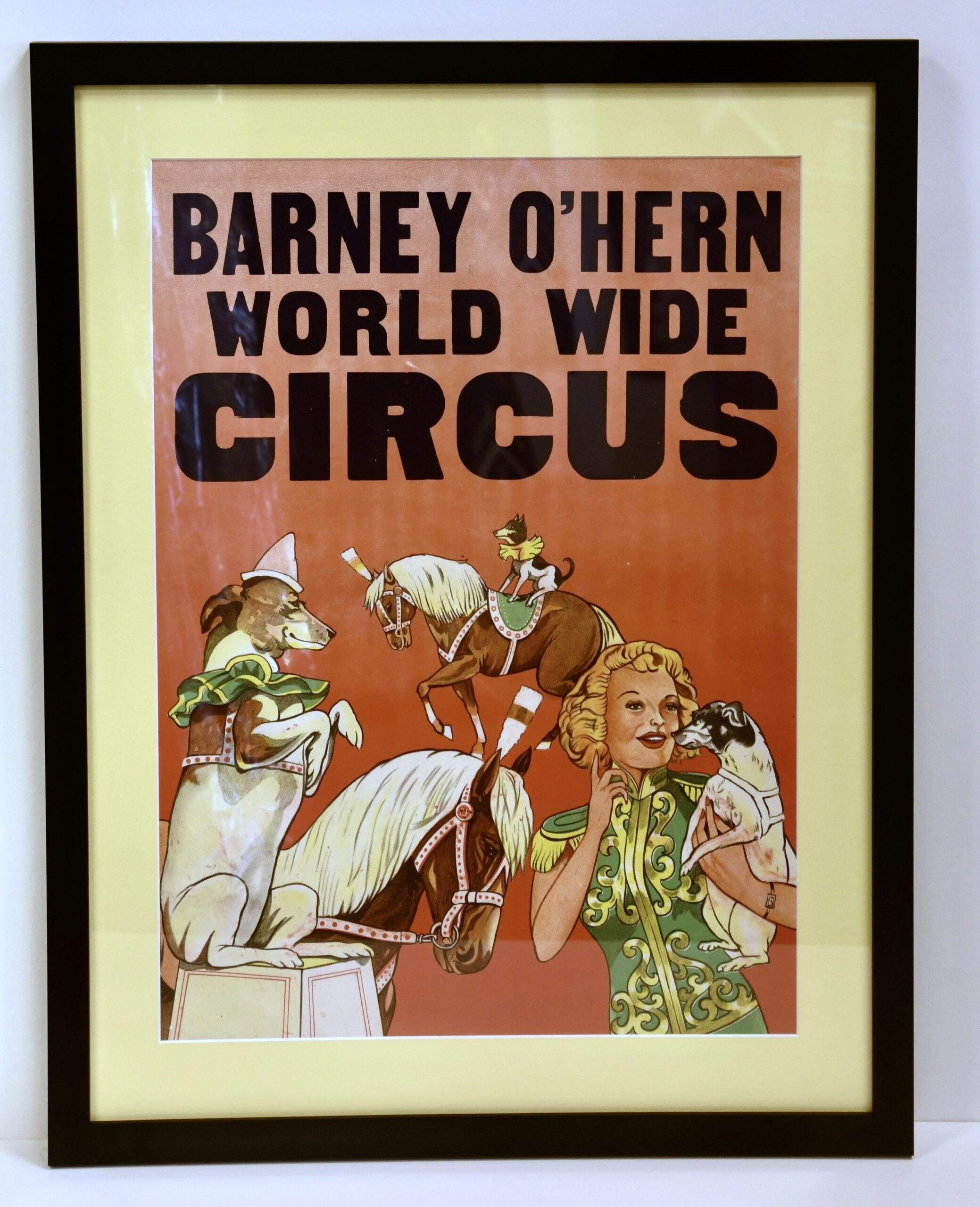
The “Barney O’Hern Circus – Dog & Pony Act” poster embodied the exuberant yet economical offset lithography of 1946, crafted for vivid roadside allure on fences and barns to entice passersby with promises of playful spectacle. Printed as a half-sheet (21×28 inches) on heavy, weather-resistant stock for easy handling by advance crews, it deployed a cheerful primaries scheme—sunny yellows for pony manes and dog coats, crimson reds for leashes and bows, and cobalt blues for the big top backdrop—against a clean white ground to pierce rural dust and distance. The central tableau pulsed with kinetic charm: a lithe woman performer in a sequined leotard and feathered cap mid-leap, one hand guiding a leaping terrier over a hurdle while the other reins a rearing pony adorned with ribbons, flanked by a chorus of tumbling pups and trotting equines in mid-gambol, evoking synchronized frolic amid faint tent stripes and acrobat silhouettes.
Typography anchored the frenzy with bold, arched sans-serif capitals for “BARNEY O’HERN WORLD WIDE CIRCUS – DOG & PONY ACT!” in 3-inch letters, accented by whimsical script for taglines like “Amazing Leaps! Adorable Tricks! Family Fun Awaits!” and a customizable lower strip for venue specifics (e.g., “Pittsburgh, PA – July 22 – 25¢ Children”). Influenced by 1930s stock illustrations from firms like Strobridge, the design fused photorealistic animal details (expressive eyes, flowing fur) with cartoonish exaggeration (oversized jumps, grinning muzzles), its fold creases, edge tears, and minor stains bearing witness to field pasting. This aesthetic bridged wartime restraint with postwar buoyancy, prioritizing accessible joy over exotic bombast to mirror the act’s intimate scale.
Cultural Significance
The “Barney O’Hern Circus – Dog & Pony Act” poster crystallized the postwar circus as a humble hearth of healing—a whirlwind of domesticated wonder that rekindled childlike delight in war-shadowed communities, where leaping dogs and ponies symbolized untrammeled play amid reconstruction’s grind. In 1946, as GIs reintegrated and families navigated atomic unease, the imagery tapped primal archetypes: the woman performer as empowered everywoman (echoing Rosie the Riveter’s pivot to glamour), dogs as loyal mischief-makers diffusing tension, and ponies as pint-sized steeds of adventure, collectively forging egalitarian revelry under canvas that knit farmers, factory folk, and youth in shared gasps. As a vestige of mud shows’ tenacity, it perpetuated Barnum’s ethos of wonder on grassroots turf, subtly nodding to gender fluidity in performance while glossing animal training’s rigors, influencing mid-century graphics and nostalgic revues like The Greatest Showman. Today, amid ethical reckonings on spectacle, it stirs tender reverence for transience, inspiring animal-free reinterpretations in contemporary circuses and discourses on heritage as communal salve in a fragmented, screen-lit world.
Production and the Company Behind It
Barney O’Hern’s World Wide Circus functioned as a bootstrapped proprietorship under Barney O’Hern’s direct stewardship from Pittsburgh, Pennsylvania, launching on a $4,000–$6,000 budget with winter rehearsals in leased lots. Infrastructure spotlighted a salvaged 60-foot single-ring tent from 1930s defuncts, an 7–9 act lineup blending O’Hern kin (his wife on wire) with freelancers, and a 20-person roustabout crew for versatile duties from rigging to refreshments. The Dog & Pony Act, a 12-minute crowd-warmer, starred 6–8 dogs (trained via treats and whistles for jumps, rolls, and bows) and 4 ponies (sourced from regional farms for gentle trots and rider assists), performed under the woman’s charismatic lead to punctuate the 85-minute bill. Posters issued in 200–400 runs by Midwestern offsets like Cincinnati’s Enquirer Job Print Co. or Pittsburgh locals employed two- to three-color presses for rapid thrift; artwork repurposed 1930s dog-pony templates, infused with O’Hern’s flair and dispatched by advance agents for wheat-paste postings two weeks prior. This variant hyped the act’s “adorable antics” for kid-centric pull, with animals housed in portable wagons for nomadic care. Post-season discards amplified survivor scarcity.
Relevant Archival Sources and Modern Interest in Such Labels
Archival Sources:
- Circus World Museum (Baraboo, WI): Preserves 1940s independent ephemera in the Robert L. Parkinson Collection, including O’Hern route sheets and poster fragments referencing dog-pony routines; digital access via Wisconsin Historical Society portal for postwar animal act studies.
- University of Iowa Libraries Special Collections (Iowa City, IA): Hake’s Americana Collection features Midwestern circus posters and programs, with 1946 O’Hern nods alongside snapshots of woman-performer-dog-horse integrations.
- Library of Congress Prints & Photographs Division (Washington, DC): Circus, Carnival, and Rodeo Poster Collection (ca. 500 items, 1840–1950) holds comparable dog-pony lithos; American Folklife Center recordings capture showmen on 1940s training tales.
- Bandwagon Magazine Archives (via Circus Fans Association of America): Digitized 1946 editions review O’Hern’s acts, detailing dog-pony highlights and designs.
This Barney O’Hern Dog & Pony poster is the sister poster of The Spec with camel, elephant and showgirls. They were produced in 1945 and are 79 years old as of 2024. Barney O’Hern Circus advertised for acts in Billboard on March 2nd, 1946. The show, run by Barney O’Hern (Owner), James O’Hern (Treasurer) and Rudy Jacobi (Manager), was a truck show that toured California and Nevada for one season only following World War II and then closed.
His son, Pat O’Hern said “My Dad took out the Barney O’Hern World Wide Circus in 1945 and part of 1946. I traveled with the show and worked in the Winter Quarters and sometimes as performer while on the road. The show was a three ring, tent show with a side show and several “pit shows” and traveled by truck. We played in both California and Nevada. “
While there are 12 different posters produced for this circus, only two were half-sheets (21” by 28”). All the others are one-sheets (42” by 28”)


Reviews
There are no reviews yet.