Mister Mistin Jr. – Ringling Bros. and Barnum & Bailey Circus

,

Mister Mistin Jr. – Ringling Bros. and Barnum & Bailey Circus

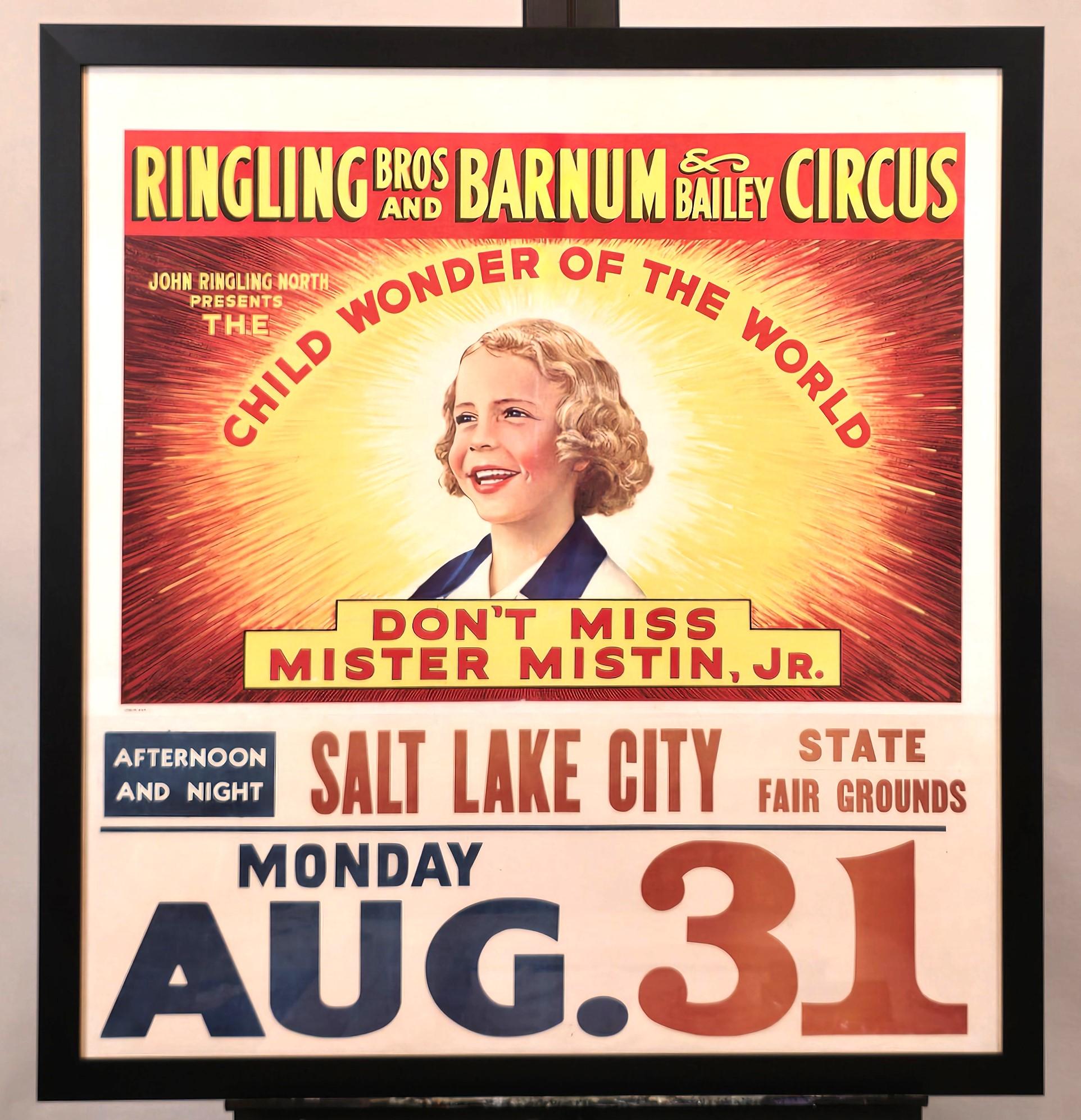
“Child Wonder of the World,” Mister Mistin Jr. This black-framed, linen-mounted poster is c.1953.

32 Inches x 30 Inches

LEASE ONLY

  • FRAMED

  • LINEN-BACKED

  • MUSEUM ACRYLIC

  • GUARANTEED ORIGINAL

Guaranteed Safe Checkout

Mister Mistin Jr.

History

“Mister Mistin Jr.” refers to a series of promotional posters featuring the child musical prodigy Roland Mistin (born ca. 1948 in Belgium), a xylophone-playing wunderkind who became a controversial star attraction for the Ringling Bros. and Barnum & Bailey Circus during its 1953 season. The act originated in Europe, where Roland, the son of Belgian xylophonist and orchestra leader Gustave “Mistin” d’Haaveloose (active since the 1910s), debuted as “Baby Mistin” at age two in 1950. Under his father’s management, the Mistin Troupe—comprising Gustave, older brother Roger (who performed skating and xylophone routines from 1942), and Roland—toured European circuses, including Cirque d’Hiver in Paris (1951), Circus Mikkenie (1951), Chipperfield’s Circus in Ireland (1952), and Cirkus Scott in Sweden (1952), where posters billed him as a polyglot prodigy fluent in five languages. Discovered by Ringling Bros. president John Ringling North during a European scouting trip, Roland was imported to the U.S. as the “Child Wonder of the World,” rebranded “Mister Mistin Jr.” to underscore his precocity and gender, and positioned as a center-ring headliner amid the circus’s postwar efforts to refresh its spectacle with novelty acts.

The 1953 Ringling tour, which played 300+ dates across arenas and under the big top, featured Roland’s 10-minute xylophone solo—classics like “The Flight of the Bumblebee”—in a Little Lord Fauntleroy velvet suit, curly blond locks, and formal bow, often with his father accompanying on piano. Billed as the season’s “mystery star,” the act drew media buzz but sparked backlash from traditionalists who deemed it “not circus” amid staples like elephants and clowns; anecdotes include Roland kicking Yankees manager Casey Stengel and swiping a fan’s cap pistol, fueling his mischievous persona. The engagement lasted one season due to mixed reception and logistical strains (e.g., child labor queries), after which the Mistins returned to Europe; Roland later appeared on TV (e.g., Abbott and Costello Show, 1954) and possibly reemerged as “Ralph Head” in the 1960s, though unconfirmed. Posters from this era, printed in the thousands, captured a pivotal moment in Ringling’s evolution from animal spectacles to diversified entertainment.

Design

The “Mister Mistin Jr.” posters exemplified 1950s offset lithography’s shift toward personalized, star-driven hype, blending childlike innocence with circus grandeur to appeal to family audiences. Primarily one-sheets (28×42 inches) or half-sheets (28×21 or 21×28 inches) on matte stock for durability during arena postings, they featured a warm gradient palette—sunny yellows fading to crimson reds evoking stage lights—against a minimalist backdrop to spotlight the subject. Central imagery portrayed Roland’s cherubic face in profile or three-quarter view: wide-eyed with flowing curls, bow tie askew, and xylophone mallets poised, rendered in soft, photorealistic detail to convey prodigious poise; subtle vignettes of musical notes or a grand tent framed him, contrasting his delicacy against the ring’s chaos.

Typography was bold and hierarchical: arched sans-serif headlines in 4-inch caps screamed “DON’T MISS MISTER MISTIN, JR. – CHILD WONDER OF THE WORLD!” in yellow-outlined red, with John Ringling North’s endorsement in elegant script below (“Presents the Musical Marvel!”); fine print touted “Xylophone Virtuoso Extraordinaire – Speaks 5 Languages!” and route details on detachable strips. European variants (e.g., 1952 Cirkus Scott) were more subdued, in blue-and-white with Roland mid-performance, measuring ca. 20×30 inches. Minor wear—closed tears, light scraping—added patina, reflecting rushed production; designs by Ringling’s press team echoed vaudeville one-sheets, prioritizing emotional pull over acrobatic flash.

Cultural Significance

The “Mister Mistin Jr.” posters embodied the mid-20th-century circus’s desperate innovation amid television’s rise, symbolizing a clash between traditional “sawdust” thrills and modern novelty in an era of child-star mania (e.g., post-Shirley Temple). As Ringling’s “mystery” import, Roland represented postwar optimism—European sophistication taming American spectacle—while his act humanized the big top, shifting focus from animal dominance to intellectual wonder, foreshadowing ethical pivots away from exploitation. Culturally, they evoked Little Lord Fauntleroy archetypes, romanticizing prodigy as aspirational escape for Depression-scarred families, yet sparked debates on child performance (e.g., “Is this circus?”), mirroring broader anxieties over youth commercialization in the Baby Boom. Anecdotes of his impishness humanized the elite Ringling brand, influencing media portrayals of circus eccentrics (e.g., in The Greatest Showman). Today, they highlight labor ethics in entertainment, evoking nostalgia for pre-digital innocence while critiquing prodigy pressures in a #MeToo-aware age.

Production and the Company Behind It

Produced under the Ringling Bros. and Barnum & Bailey Combined Shows, Inc.—a family-run behemoth headquartered in winter quarters at Sarasota, FL, and led by John Ringling North—the posters were part of a $50,000+ seasonal publicity blitz for the 1953 Blue Unit tour, which grossed millions across 32 weeks. Roland’s act, managed by Gustave d’Haaveloose as the Mistin Troupe, integrated into a three-ring spectacle: 10-minute center-ring slots amid 2-hour programs with 1,200 performers, 300 animals, and 50+ acts, transported by 60-train cars. Production emphasized hype—advance agents plastered 500–1,000 sheets per city weeks ahead—using offset presses for speed and color fidelity; designs by in-house illustrator Roland C. Butler (circus press agent since 1918) focused on “star billing” to counter slumping attendance. European precursors were hand-printed for smaller runs (200–300) by local firms like those for Cirkus Scott. The troupe’s U.S. visa and logistics cost thousands, with Roland’s fee negotiated as a percentage; post-season, the act’s brevity stemmed from audience fatigue with non-acrobatic novelties.

Relevant Archival Sources and Modern Interest in Such Labels

Archival Sources:

  • The John and Mable Ringling Museum of Art (Sarasota, FL): eMuseum collection includes the original “Don’t Miss Mister Mistin, Jr.” one-sheet (ca. 1953) in its Circus Poster Archives, alongside route books and Butler sketches; digitized for research on 1950s novelties.
  • Circus World Museum (Baraboo, WI): Robert L. Parkinson Library holds 1953 Ringling programs, photos of Roland’s debut, and ephemera from the Mistin Troupe; Facebook features (e.g., 2020 post) highlight his prodigy status, with oral histories from alumni.
  • Library of Congress Prints & Photographs Division (Washington, DC): Circus Poster Collection (1840–1960) proxies via Butler’s Ringling files, including xylophone act broadsides; folklife recordings capture 1950s scouting tales.
  • Erfgoedbank Midwest (Belgium): Digital archive [ADP20120425_013] details the Mistin family genealogy and European tours, with scans of 1951–1952 posters.
Weight 7.8 lbs
Dimensions 30 × 32 in
Framed

Black

Linen Mounted Selection

Yes

Reviews

There are no reviews yet.

Be the first to review “Mister Mistin Jr. – Ringling Bros. and Barnum & Bailey Circus”

Your email address will not be published. Required fields are marked *

Shopping Cart
Scroll to Top