
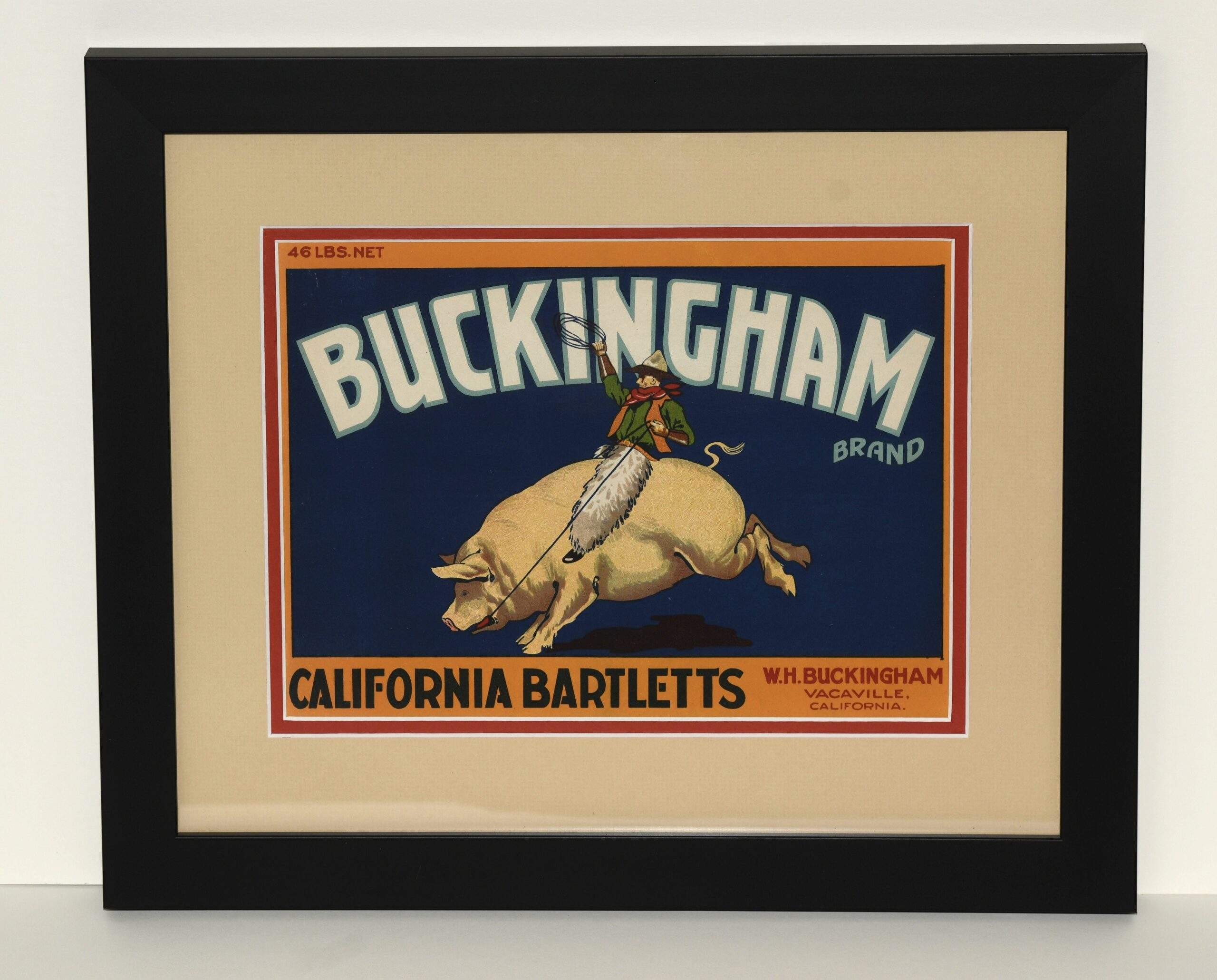
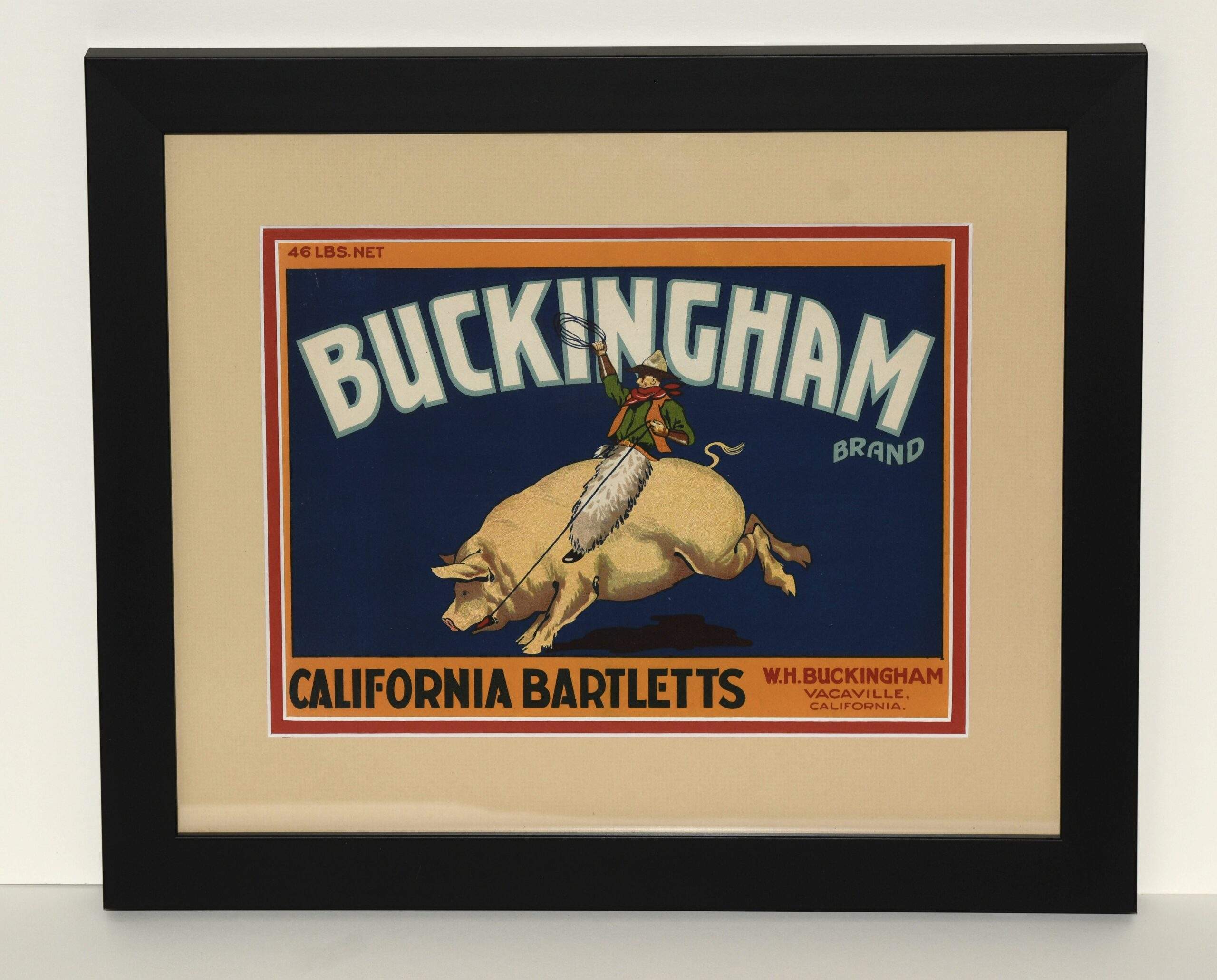
Buckingham California Bartletts Fruit Label c. 1920
The Buckingham Brand fruit label was produced in the 1920s, aligning with the broader “Golden Era” of California fruit crate labels (roughly 1900–1940), when vibrant, lithographed designs were at their peak for marketing fresh produce shipped via rail.
This is based on the label’s artistic style—featuring bold, colorful lithography with whimsical imagery (e.g., a cowboy riding a pig, a pun on “Buckingham”)—which was characteristic of 1920s designs emphasizing humor and regional Western themes. Earlier labels (1880s–1910s) were simpler and more ornate, while post-1930s styles shifted toward geometric or Depression-era minimalism. The transition to pre-printed cardboard boxes in the 1940s–1950s marked the end of such pasted labels. Uncertainties include minor variations in printing runs, but archival records consistently date this specific label to 1920–1929.
The label emerged during California’s post-World War I agricultural boom, when Vacaville—known as the “Pear Capital of the World”—saw explosive growth in pear production. Bartlett pears, the focus of this label, were a staple crop, shipped nationwide via refrigerated rail cars to combat spoilage during long hauls. By the 1920s, at least 28 large produce companies operated in Vacaville, transforming the area from a modest 1843 Mexican land grant into a horticultural hub with over 500 farms by 1930. Labels like Buckingham Brand played a key role in branding and standardization, helping small growers compete with larger co-ops amid economic pressures like the looming Great Depression.
W.H. Buckingham was a local grower and packer who leveraged the fertile soils of Solano County’s Central Valley for pear cultivation. His operations reflected broader innovations, such as improved packing techniques and cold storage, which extended shelf life and enabled exports. This era also saw industry challenges, including labor disputes and competition from other regions, but Vacaville’s mild climate and irrigation advancements solidified its dominance in pears (California produced about 144,740 tons annually by the late 20th century, with roots in 1920s practices).
The label’s production coincided with the formation of marketing co-ops like Sunkist (1893, expanded in the 1920s) and the California Fruit Exchange, which pooled resources for rail shipping. The 1920s rail boom facilitated Vacaville’s growth, but the 1926 closure of nearby firms like L.W. and F.H. Buck Company due to competition foreshadowed industry consolidation.
The label’s central image—a cowboy riding a bucking pig (a playful pun on “Buckingham”)—embodies 1920s Western humor and frontier mythology, evoking California’s ranching heritage and the romanticized “Wild West” popularized by silent films and rodeos. This whimsical, anthropomorphic design reflects the era’s advertising trends, where labels served as “windows to Sunny California,” blending folklore with product promotion to appeal to Eastern urban consumers craving exotic, sun-ripened fruit.
Rooted in Vacaville’s rural traditions, the label highlights the area’s Mexican land grant origins (1843) and transition to Anglo-American agriculture, symbolizing Manifest Destiny and agricultural prosperity. It mirrors early 20th-century cultural shifts: the rise of consumer branding amid urbanization, ethnic themes in marketing (e.g., Native American motifs in other labels), and a celebration of local identity amid national homogenization. Broader trends included gender and racial stereotypes in some labels, but this one’s lighthearted pun prioritizes accessibility and joy, capturing the Roaring Twenties’ optimism before the Depression.
Vintage labels like this have preserves snapshots of American life—scenery, lifestyles, and humor—from the 1900s, often featured in museums and books as artifacts of migration, railroads, and the “Golden State” mythos.
W.H. Buckingham operated as a family-run grower and packer in Vacaville, California, focusing primarily on Bartlett pears—a juicy, yellow-green variety ideal for fresh markets and canning. Founded in the early 1900s amid Vacaville’s pear surge, the business used the “Buckingham Brand” to market its output, with the label pasted on wooden crates for shipment. Key figure W.H. Buckingham managed operations from local orchards, emphasizing quality packing to meet national demand.
Based in Vacaville’s fertile valley, the company handled harvesting, sorting, and crating of pears, shipping via rail to East Coast markets. Bartletts were the star product, benefiting from the region’s climate (pears thrive in July–December seasons), with yields supporting small-scale but efficient enterprises. No records indicate large-scale expansion, but it aligned with Vacaville’s 1920s economy, where pears drove growth alongside prunes and grapes.
Likely affiliated with regional groups like the California Fruit Exchange (formed 1901) for collective marketing and rail logistics, though specific ties are unconfirmed. No major mergers are noted, but the brand’s operations paralleled prominent Vacaville families like the Bucks (e.g., L.W. & F.H. Buck Co., closed 1926), who influenced pear and prune industries. The brand faded with the 1940s shift to cardboard boxes, leaving no modern successors; today, Vacaville’s pear legacy continues through firms like Vacaville Fruit Company (est. 1960, focused on dried fruits). For verification, consult Solano County archives or the Citrus Label Society.
The label appears authentic based on archival matches and collector verification’s; however, reproductions exist in merchandise. To confirm, cross-reference with physical examples at the California State Railroad Museum or Vacaville Museum, or consult label experts via the International Association of Printing House Craftsmen.
(https://www.digitalcommonwealth.org/search/commonwealth:b2774441x)
Reviews
There are no reviews yet.