
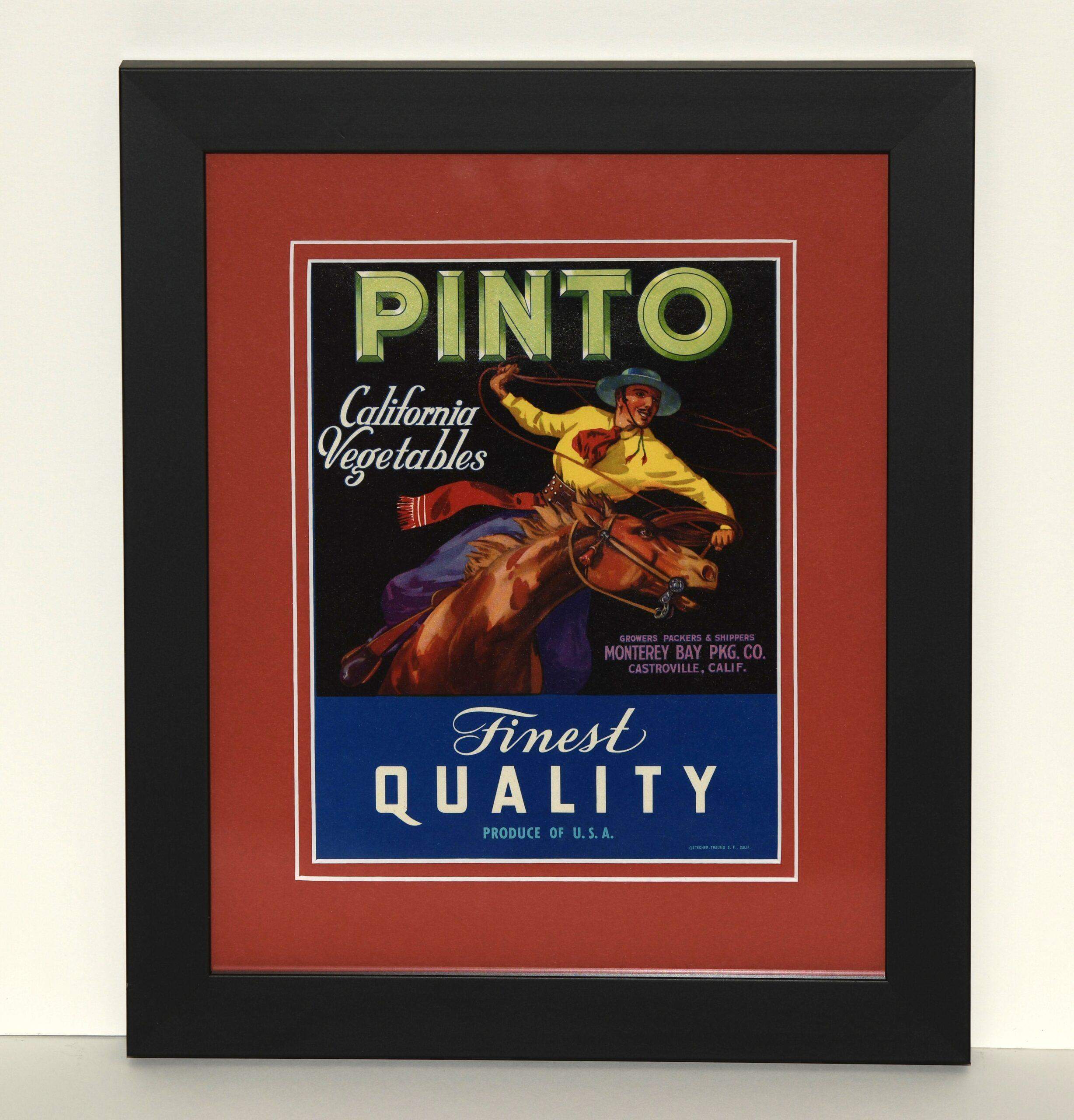
Pinto California Vegetables Crate Label C. 1930
Our framed, matted, and acrylic-protected Pinto vegetable label is an original vintage crate label used primarily in the 1930s to 1950s for marketing produce, particularly from the Monterey Bay Packing Company in Castroville, California. These labels were essential for branding and differentiating products at farmer markets during that era. We lease to display art to a variety of professionals businesses, their lobbies and offices, real estate staging companies, brokers and agents.
The Pinto California Vegetables label was produced circa 1930s–1950s, during the peak of wooden crate labeling for fresh produce in California’s vegetable industry (approximately 1890s–1950s), before the widespread adoption of pre-printed cardboard boxes in the 1950s–1960s.
The label’s design, featuring bold lithography, vibrant colors, and Western-themed imagery (e.g., a vaquero cowboy riding a pinto horse), aligns with mid-20th-century prints from San Francisco lithographers like Stecher-Traung, common for Salinas Valley packers. Archival reproductions and collector listings date similar labels to the 1930s–1950s, with the era’s end tied to post-WWII packaging shifts; uncertainties include exact print runs, but no evidence predates the 1920s or extends beyond the 1950s for this specific Monterey Bay variant.
The label emerged in the Salinas Valley—dubbed the “Salad Bowl of the World”—amid the early 20th-century vegetable boom, fueled by irrigation advancements, refrigerated rail cars, and migrant labor from the Dust Bowl era (1930s). It branded crates for shipping hardy produce like beans, corn, peas, and artichokes to national markets, helping small packers compete in a market where California supplied over 50% of U.S. vegetables by the 1940s; Castroville, known as the “Artichoke Capital,” shipped thousands of tons annually via Southern Pacific rail.
Monterey Bay Packing Company’s Contributions: Established in the early 1900s as a grower-owned cooperative in Castroville (near Salinas), the company focused on efficient harvesting, grading, and crating for export. It innovated with cold storage to preserve freshness during cross-country hauls, supporting the valley’s growth from family farms to industrial-scale operations during WWII, when vegetable demand surged for military rations. By the 1950s, it handled seasonal peaks (e.g., summer peas, fall beans), but faded with industry consolidation.
The 1930s Dust Bowl migrations brought thousands of laborers to Salinas farms, shaping labor practices amid strikes (e.g., 1934 Salinas Lettuce Strike); WWII rationing boosted vegetable output, but post-war mechanization and cardboard boxes ended label use. The company’s legacy ties to broader Salinas history, including John Steinbeck’s depictions of valley agriculture.
The label’s central motif—a vaquero (Mexican cowboy) astride a spotted pinto horse against a ranch backdrop—uses dynamic, lithographic illustration in earthy tones, evoking motion and frontier spirit typical of 1930s–1950s Western-themed produce art that turned crates into eye-catching “billboards” at markets.
Rooted in Monterey County’s ranching and farming heritage (from Spanish vaquero traditions to Anglo-American agribusiness), the pinto horse symbolizes the wild, resilient American West, reflecting California’s multicultural labor force (e.g., Mexican and Filipino workers in fields). It mirrors Depression-era optimism and post-WWII prosperity, promoting “heartland” produce as wholesome and adventurous to urban consumers, while subtly nodding to ethnic influences in a region shaped by migration and folklore.
As collectibles, these labels capture Salinas’ “Salad Bowl” mythos, appearing in exhibits on agricultural Americana and inspiring modern art; they highlight themes of hard work, diversity, and environmental ties, echoing Steinbeck’s works and contemporary farm-to-table movements.
Monterey Bay Packing Company, a small-scale packer in Castroville, California (near Salinas), operated in the early 1900s–1950s, focusing on fresh vegetables. The Pinto Brand targeted pinto beans (nodding to the horse motif), corn, peas, and artichokes—staples suited to the valley’s cool fog and fertile soils—for fresh markets. Key figures are unrecorded, but it was likely family-run, emphasizing “Finest Quality Produce of U.S.A.” for branding.
From facilities in Castroville, it managed harvesting from local 10–50-acre farms, packing into wooden crates (7″x9″ labels), and shipping via rail to East Coast wholesalers. Seasonal operations peaked in summer–fall, with emphasis on quality grading; no canning noted, focusing on fresh distribution amid rising demand.
Likely affiliated with the California Vegetable Growers Association (est. 1920s) for marketing and rail logistics; partnerships included Southern Pacific Railroad for transport. No major mergers recorded, but it paralleled larger Salinas firms like Mann Packing (now Fresh Del Monte). The brand ceased with cardboard shifts; legacy lives in collector archives, with no modern successors, though Castroville’s artichoke industry persists via groups like the Castroville Artichoke Festival.
Websites and Information Sites
UC Davis, University Library, Special Collections Lug and Can Label Collection
Reviews
There are no reviews yet.