
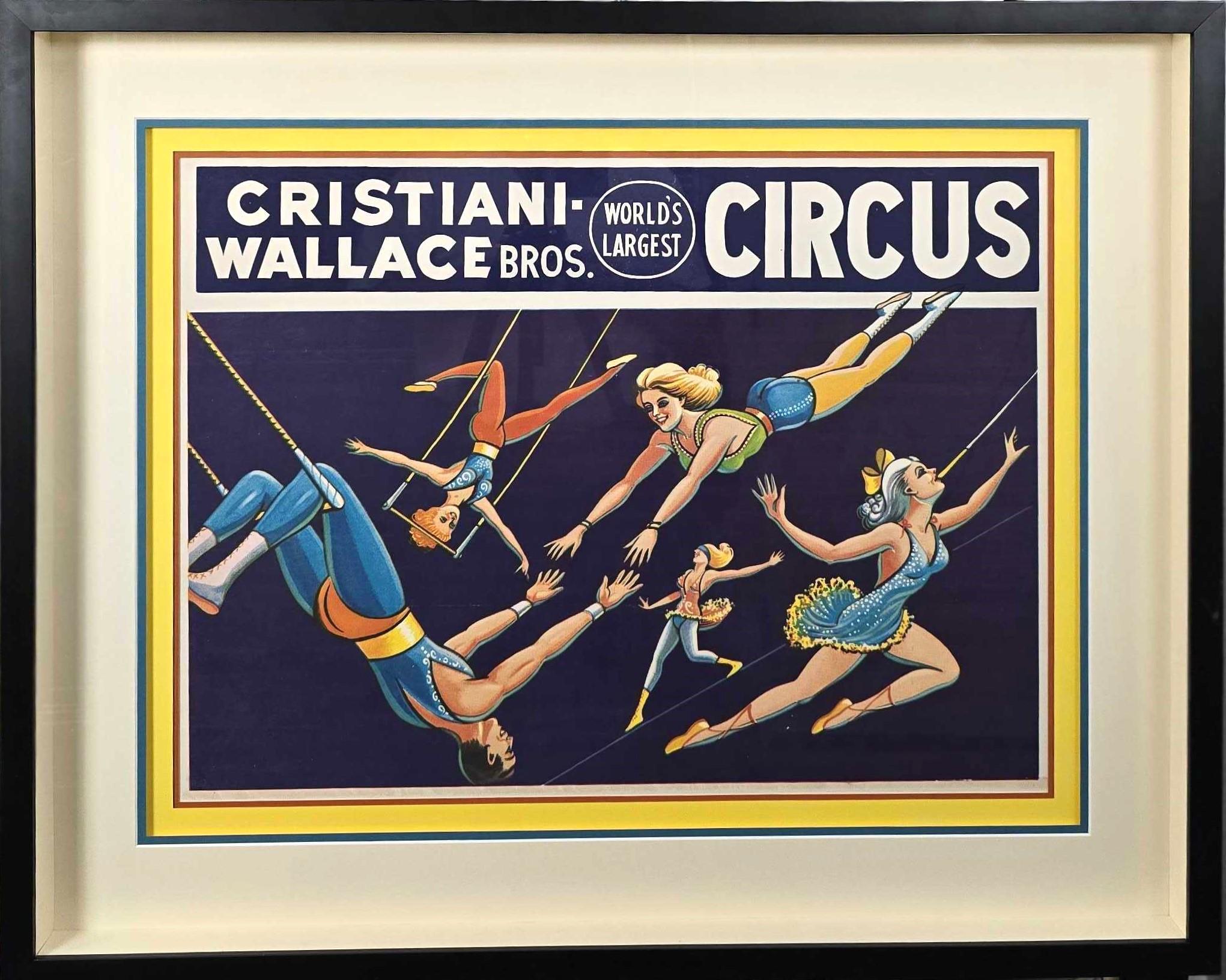
Cristiani-Wallace Bros. – World’s Largest Circus – C. 1950
History
The Cristiani-Wallace Bros. Circus emerged as a family-driven tent show in the early 1960s, rooted in the storied legacy of the Italian Cristiani family, renowned equestrians tracing their circus origins to 1840 when Emilio Cristiani joined a troupe in Pisa, Italy. Discovered in Brussels by Ringling Bros. scout Pat Valdo in 1933, the family immigrated to the U.S. in 1934, debuting at Madison Square Garden before disputes shifted them to Hagenbeck-Wallace, where they honed bareback riding and acrobatics through the 1930s with Al G. Barnes-Sells Floto. By the 1940s, they starred with Ringling Bros. until 1943, then launched Cristiani Bros. Circus (1956–1960), a one-ring operation with family acts, animals, and concessions, pioneering overland tours to Alaska in 1954.
Pete Cristiani, injured young but adept at concessions, founded Wallace Bros. Circus in 1961 using his father-in-law Ben Davenport’s title, touring old Cristiani routes east of the Mississippi. Rebranded Cristiani-Wallace Bros. by 1962–1966, it operated as a single-ring tented show with a 10–12 act program: Cristiani equestrian feats, elephants (five gifted at Pete’s 1950 wedding), tigers, clowns, aerialists, and a live band led by Howard Stratton. Winter quarters were in Sarasota, FL; tours hit fairs and lots in Florida, Georgia, and the Northeast, facing 1960s challenges like rising costs and competition from TV. It downsized in 1965, ended in the red, and folded by 1966, with Pete renting routes to Von Bros.; assets dispersed, marking the Cristiani dynasty’s shift from performers to independents amid big top decline.
Design
Cristiani-Wallace Bros. posters epitomized 1960s offset lithography’s bold, nostalgic flair, blending family heritage with spectacle to lure rural crowds. Typically half-sheets (21×28 inches) or one-sheets (28×42 inches) on heavy stock, they burst with primaries—fiery reds for tigers, sunny yellows for tents, earthy browns for elephants—against white fields for distant readability. Designs centered dynamic vignettes: rearing elephants with showgirls perched on tusks, snarling tigers in mid-leap, clowns tumbling amid horses, and bareback riders (Cristiani signatures) in mid-somersault, evoking controlled chaos. Backgrounds featured striped big tops and safari motifs (“Giant Safari Parading 12 Noon”), with sans-serif block fonts arching “CRISTIANI-WALLACE BROS. CIRCUS” over script taglines like “Thrilling Equestrian Feats! Colossal Menagerie!” and customizable date strips.
Stock elements from prior Cristiani Bros. eras (e.g., sepia-toned family portraits or chariot races) were reused, adapted from printers like Globe Poster Corp. or Central Show Print, with fold lines and paste remnants signaling field use. This hyperbole-laden style, echoing 1930s Strobridge lithos, prioritized fantasy over realism, masking modest scales with Cristiani glamour.
Cultural Significance
Cristiani-Wallace Bros. Circus symbolized the immigrant dream realized in sawdust rings, embodying mid-20th-century America’s fascination with equestrian artistry and family dynasties amid suburban sprawl and media shifts. As heirs to Italy’s “Royal Family of the Circus,” the Cristianis fused European tradition with U.S. spectacle, their bareback leaps representing resilience—from Ellis Island arrivals to Alaskan frontiers—while highlighting gender roles (showgirls as icons) and animal-human bonds in pre-welfare reform eras. The show fostered communal escapes in fading rural towns, boosting fairs and evoking Barnum’s wonder, yet underscored big top vulnerabilities: labor strikes, economic woes, and ethical animal debates that foreshadowed Ringling’s 2017 closure.
Posters and ephemera preserve this as vernacular Americana, influencing pop culture from The Greatest Showman to folk revivals, while prompting reflections on exploitation versus joy in itinerant arts— a poignant relic of circus as social glue in pre-digital heartlands.
Production and the Company Behind It
Cristiani-Wallace Bros. Circus Company was a Cristiani family proprietorship, owned by Pete Cristiani (manager) and wife Norma (née Davenport), operating from Sarasota, FL, winter quarters shared with Cristiani kin. Production emphasized mobility: a 60–80-foot single-ring big top seating 1,000–1,500, trucked east of the Mississippi for 80–100 stands at fairs and lots; acts included family equestrians (10+ Cristianis), five elephants, tigers, clowns, aerialists (e.g., Pauline Penny), and a 10-piece brass band. Pete handled concessions and logistics, drawing from 1950s Cristiani Bros. assets like trucks and animals; costs stayed low via multitasking (family doubling roles) on a $20,000–$30,000 seasonal budget.
Posters, key to hype, were produced in 300–500 runs by regional firms like Acme Show Print (Kansas City) or Enquirer (Cincinnati), using offset for affordability; advance crews pasted them weeks ahead, customizing with routes (e.g., Eau Gallie, FL, 1962). Tickets and brochures featured tiger motifs for sideshows; the 1966 finale included menagerie and “Colossal Side Shows.”
Relevant Archival Sources and Modern Interest in Such Labels
Archival Sources:
- Circus World Museum (Baraboo, WI): Holds routes, programs, and photos from 1962–1966 in the Robert L. Parkinson Collection; includes band recordings and Cristiani ephemera, digitized via Wisconsin Historical Society.
- Library of Congress Prints & Photographs Division (Washington, DC): Cristiani Bros. posters (e.g., “Giant Safari,” n.d.) in Circus Poster Collection (1840–1950); extends to Wallace variants via folklife recordings on family acts.
- The Huntington Library (San Marino, CA): Jay T. Last Collection features 1950s–1960s lithos, including elephant-showgirl designs; searchable for Cristiani-Wallace routes and ads.
- Circus Historical Society Archives (via circushistory.org): Route books (1962–1966) and newsletters like Advance Car, detailing production and acts; includes oral histories from Pete Cristiani.
Cristiani – Wallace Bros. – World’s Largest Circus. This poster is a beautiful illustration of trapeze artists on a deep blue background. Linen backed. Unframed size 21″ x 28”. Matted, 3D framed with museum acrylic protection.
After successfully operating the King Bros Cristiani Circus with partner Floyd King in the 1950s the Cristiani family opened the Cristiani Wallace Bros Circus, a medium sized circus operating in the early 1950’s and 1960s. The show was owned by the Cristiani family and managed by Pete Cristiani. The circus toured mostly states east of the Mississippi.
Reviews
There are no reviews yet.