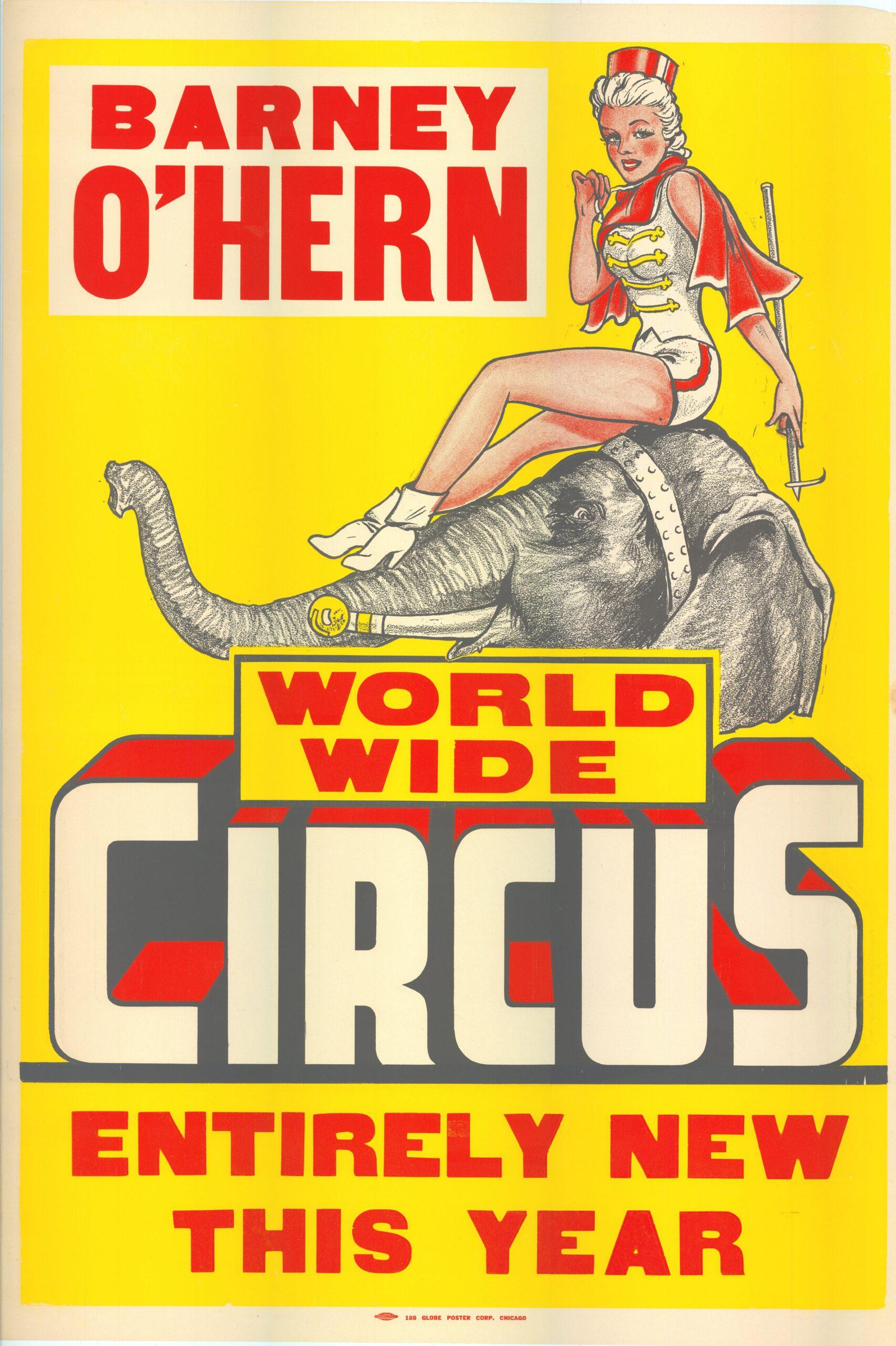
Barney O’Hern Circus Poster with Showgirl & Elephant
History
The Barney O’Hern Circus, formally Barney O’Hern’s World Wide Circus, was a transient postwar American tent show that operated exclusively during the 1946 season, riding the wave of renewed demand for live, communal entertainment as the United States transitioned from World War II to peacetime prosperity. Founded by Barney O’Hern, a grizzled showman with decades of experience in vaudeville, carnival concessions, and sideshow management for larger operations like the Hagenbeck-Wallace Circus, the venture aimed to deliver a compact one-ring spectacle to underserved rural and small-town audiences in the Midwest and Northeast. O’Hern, who cut his teeth in the 1920s promoting acts and handling logistics, cobbled together a modest ensemble of equestrians, wire walkers, trained animal performers (including dogs, ponies, and reportedly a single elephant for novelty parades), and glamorous showgirls to add a touch of extravagance. The circus logged 40–50 performances across states like Ohio, Pennsylvania, New York, and Illinois, frequently tying into local fairs, veterans’ events, and open lots under a secondhand big top accommodating 800–1,000 patrons. However, postwar hurdles—lingering fuel shortages, veteran labor disruptions, equipment failures, and budding competition from radio and television—proved insurmountable, forcing liquidation of assets at season’s end to cover debts. O’Hern reverted to carnival circuits, cementing the show’s status as a classic “one-season wonder” in circus lore. The “Barney O’Hern Circus Poster with Showgirl & Elephant” embodies this brevity, likely a promotional variant from the 1946 tour emphasizing exotic allure to lure crowds to venues like the Summit County Fair or Scranton-area stands, where the elephant (a rented or borrowed asset) featured in simple trunk-raise or platform routines alongside showgirl interactions.
Design
Barney O’Hern posters, including the showgirl-and-elephant iteration, captured the vivacious yet thrifty offset lithography of the mid-1940s, crafted for bold visibility on rural barns and billboards with minimal production costs. Standard half-sheet dimensions of 21×28 inches ensured easy transport by advance crews, printed on sturdy, weather-resistant stock in a lively array of primaries—fiery reds for excitement, sunny yellows for optimism, and earthy browns for the elephant’s textured hide—against a clean white field to pop against overcast skies. The layout spotlighted a central vignette: a poised showgirl in a sparkling headdress and flowing gown, arm extended in dramatic flourish toward a majestic elephant rearing on hind legs, trunk curled in salute, evoking a fusion of feminine elegance and untamed wonder; subtle background flourishes like a striped tent or distant acrobats hinted at the full program without overwhelming the composition. Typography roared with bold, arched sans-serif capitals for “BARNEY O’HERN WORLD WIDE CIRCUS,” accented by whimsical script for phrases like “Exotic Thrills! Majestic Marvels!” and a peelable lower strip for venue-specific details (e.g., “Erie, PA – Aug. 15 – 25¢ Adm.”). The elephant’s rendering drew from stock exoticism tropes, with realistic folds and tusks contrasted against the showgirl’s idealized, pin-up silhouette reminiscent of Victory Bond posters, while fold creases and edge wear from field use lent an air of authentic grit. This design mirrored the era’s shift from wartime austerity to buoyant fantasy, prioritizing allure over opulence to mirror the show’s intimate scale.
Cultural Significance
The Barney O’Hern Circus posters, especially those pairing the showgirl with the elephant, symbolized the circus as a postwar phoenix—a grassroots antidote to rationing and rationed joy, injecting fleeting splendor into the daily grind of America’s heartland. In 1946, as demobilized soldiers and war-weary families craved normalcy, the imagery tapped archetypal dreams: the showgirl as beacon of restored glamour and femininity amid Rosie-the-Riveter echoes, the elephant as colossus of exotic escape and imperial might tamed for delight, collectively promising a brief reprieve from reconstruction woes. These visuals fortified the big top’s role as itinerant agora, where diverse locals—miners, farmers, and kids—converged for shared awe, perpetuating P.T. Barnum’s democratized wonder but in pared-down, hyper-local form. As emblem of the “mud show” twilight—humble, hardship-forged troupes before animal ethics and mass media reshaped spectacle—the posters underscore entrepreneurial pluck in mid-century flux, subtly nodding to gender dynamics (showgirls as aspirational icons) and animal symbolism (elephants as bridges between wild and civilized). In contemporary lens, they stir wistful reverence for transience, fueling narratives in revivals like Cirque du Soleil or films such as Water for Elephants, while sparking discourse on historical exploitation in pursuit of communal catharsis.
Production and the Company Behind It
Barney O’Hern’s World Wide Circus functioned as a bootstrapped proprietorship under Barney O’Hern’s Pittsburgh-based helm, launching on a lean $4,000–$6,000 outlay with winter prep in rented lots. Core infrastructure featured a salvaged 60-foot single-ring tent from shuttered 1930s outfits, an 7–9 act bill blending O’Hern relatives (his spouse on aerials) with freelance talent, and a 20-strong roustabout team juggling stakes, spotlights, and ticket sales. The elephant, a seasonal loaner from regional menageries, starred in low-key segments like showgirl-led processions, while showgirls amplified visual pop in brief, sequin-laden interludes to stretch the 80-minute runtime. Posters rolled off Midwestern presses like Cincinnati’s Enquirer Job Print Co. or Pittsburgh independents in lots of 200–300, leveraging two-color offset for swift, economical runs; artwork repurposed 1930s elephant motifs from litho libraries, tailored with O’Hern flair and dispatched via scouts for pasting two weeks ahead. This variant hyped the “elephant extravaganza” for family draw, with beasts minimally trained for safety via positive cues. Surplus sheets post-tour were trashed or salvaged, heightening survivor rarity.
Relevant Archival Sources and Modern Interest in Such Labels
Archival Sources:
- Circus World Museum (Baraboo, WI): Curates 1940s indie ephemera in the Robert L. Parkinson Collection, encompassing O’Hern route logs and poster remnants; digitized via Wisconsin Historical Society for insights into fleeting postwar ventures.
- Library of Congress Prints & Photographs Division (Washington, DC): Encompasses the Circus, Carnival, and Rodeo Poster Collection (ca. 500 items, 1840–1950), with analogous 1940s lithos and folklife tapes from the American Folklife Center on showmen navigating reconversion.
- Princeton University Library Miscellaneous Circus Collection (Princeton, NJ): Houses subject files on acts and outfits, including elephant photos, broadsides, and clippings from one-season shows; open for researcher queries on 1940s independents.
- University of Iowa Libraries Special Collections (Iowa City, IA): Stocks Midwestern fair posters in the Hake’s Americana archives, referencing O’Hern alongside 1946 snapshots of animal integrations.
This authentic one-sheet upright poster (42 inches tall by 28 inches wide) was printed for the Barney O’Hern Circus of 1946. The Barney O’Hern circus was started as a truck circus in the months immediately following World War II, and while it closed shortly after it opened, the posters for this show were quite attractive, indicative of 1940s circus art, and are highly collectible.
Reviews
There are no reviews yet.