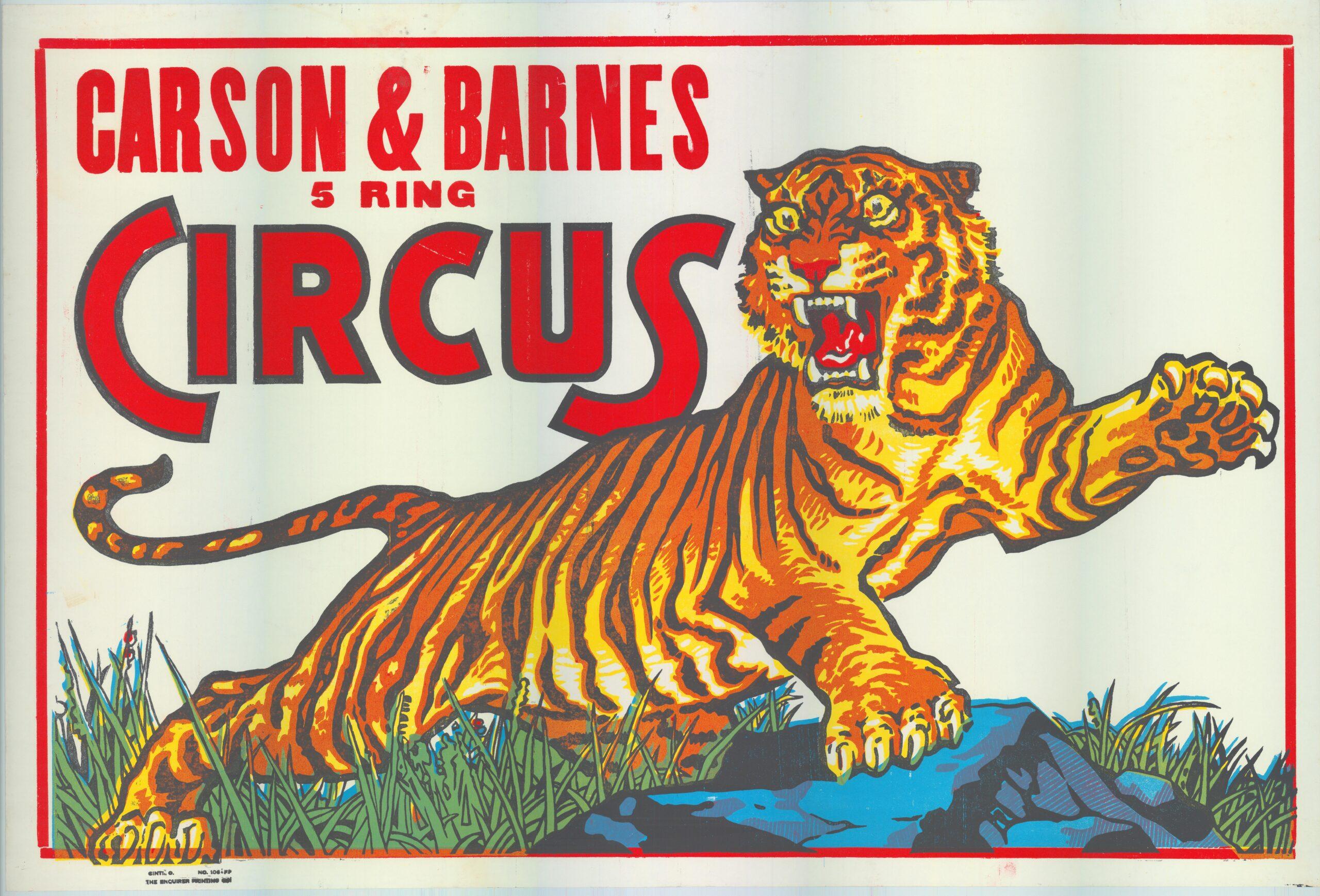
Carson & Barnes Circus Tiger
History
The Carson & Barnes Circus, often referred to as the “World’s Largest 5-Ring Circus” in its promotional materials, traces its roots to the late 1930s as a modest “dog and pony” show founded by Obert Miller in Smith Center, Kansas. By the 1940s, under the leadership of Miller’s son, D.R. Miller, it evolved into a full-fledged big top operation, incorporating wild animal acts that became its hallmark. The name “Carson & Barnes” emerged in the early 1950s through a complex business arrangement following the death of Jack Moore, the original owner of the Tex Carson Circus. D.R. Miller settled with Moore’s widow, Angela, acquiring the title and rebranding his show accordingly, while integrating elements from the historic Al G. Barnes Circus (1898–1938), a renowned “Wild Animal Show” known for its exotic menageries and trainers like Mabel Stark. This merger infused Carson & Barnes with a legacy of spectacle, including tiger acts that echoed the Al G. Barnes tradition of featuring Bengal tigers in daring performances.
The “Carson & Barnes Circus Tiger” refers to iconic advertising posters and labels prominently featuring tigers, often in dynamic poses like leaping through fire rings or riding elephants, which promoted the circus’s wild animal exhibitions from the 1940s through the 2000s. These visuals debuted in the post-World War II era, with silkscreen and offset prints advertising multi-ring spectacles in towns across the U.S. and Canada. The circus toured seasonally, wintering in Hugo, Oklahoma (its longtime headquarters), and emphasized family-run operations across four generations, with Barbara and Geary Byrd managing daily affairs by the 21st century. Tiger acts were central, drawing from a menagerie that included up to 20 big cats at peak, trained for routines involving hoops, pedestals, and trainer interactions. The show faced challenges, including USDA citations for animal transport issues (e.g., a 1990s tiger escape named Shawana) and PETA exposés on elephant abuse in the 2000s, leading to a shift away from animal acts by the 2010s amid welfare reforms. Carson & Barnes ceased operations in 2023 after an 85-year run, marking the end of one of America’s last traditional tent circuses.
Design
Carson & Barnes tiger posters epitomized mid-20th-century circus lithography, blending bold graphics with hyperbolic imagery to evoke primal excitement and exotic allure. Designs often measured 21×28 inches (half-sheets) or larger (up to 52×76 inches for four-sheets), printed in vibrant primaries—fiery oranges, deep blacks, and electric yellows—on heavy stock paper for durability during outdoor posting. Central motifs featured snarling or leaping tigers, sometimes superimposed on circus tents or paired with elephants for a “tiger riding elephant” trope symbolizing controlled wilderness. Typography used exaggerated sans-serif fonts for headlines like “Thrilling Wild Animal Acts” or “Carson & Barnes 5-Ring Circus,” with route-specific date nails added for local customization.
Key examples include:
- 1940s Silkscreen Poster (Library of Congress): A 53×71 cm color print depicting three-ring chaos with tigers amid acrobats and clowns, emphasizing the “wild animal circus” theme.
- 1965 Acme Print (Hugo, OK): A 42×28 inch reissue of a 1930s design showing a tiger atop an elephant against a cage backdrop, promoting a Hemet, CA, show; noted for its photorealistic animal rendering and edge wear from use.
- 2000 Fire Ring Variant: A half-sheet with a tiger mid-leap through flames, highlighting late-era spectacle amid growing animal rights scrutiny.
These designs drew inspiration from earlier masters like Charles Livingston Bull’s 1914 leaping tiger (used by Ringling Bros.), adapting it for Carson & Barnes’ rustic, family-oriented appeal.
Cultural Significance
The Carson & Barnes tiger imagery encapsulated the golden age of American tent circuses as communal rituals of wonder and escapism, particularly in rural heartlands where the show toured fairs and lots, fostering intergenerational bonds and economic boosts for small towns. Tigers symbolized the taming of the “wild”—a metaphor for post-Depression resilience and mid-century optimism—while underscoring ethical tensions in entertainment, as acts glorified dominance over nature amid emerging conservation awareness. Inherited from Al G. Barnes’ legacy of Mabel Stark’s pioneering tiger training (1911–1930s), these visuals perpetuated a narrative of human-animal harmony that masked grueling travel and training rigors, influencing pop culture from films like King of the Jungle (1933) to modern nostalgia in The Greatest Showman.
By the 2000s, the posters became flashpoints in debates over animal exploitation, with USDA reports and PETA footage highlighting tiger escapes and inadequate enclosures, accelerating the phase-out of wildlife acts and reflecting broader cultural shifts toward ethical entertainment. Today, they evoke bittersweet Americana, celebrating circus folklore while prompting reflection on progress in animal rights.
Production and the Company Behind It
Carson & Barnes Circus Company, a family-owned enterprise headquartered at 2694 E 2070 Rd, Hugo, OK, produced these posters in-house or via regional printers to support its nomadic operations: a 5-ring big top seating thousands, a 10–15 act program with tigers sourced from auctions and trained on-site, and a crew of 100+ including generational performers. Primary printers included Acme Show Print (Hugo, OK) for 1960s lithographs and Enquirer Job Print Co. for earlier offsets, with runs of 500–1,000 sheets per design distributed via advance crews for barn and billboard postings weeks ahead. Tiger labels—smaller adhesive or sticker variants—were used for promotional tie-ins like souvenir programs or trucker caps, emphasizing the “Tiger Act” as a draw. Under D.R. Miller’s vision of “bigness,” production prioritized affordability and mobility, with winter quarters doubling as design hubs for customizing visuals with local dates.
Relevant Archival Sources and Modern Interest in Such Labels
Archival Sources:
- John and Mable Ringling Museum of Art (Sarasota, FL): Extensive collection including “Carson & Barnes: Tiger Riding an Elephant” (Acme, undated) and routebooks (e.g., 1986 edition); digitized records via eMuseum.
- Library of Congress Prints & Photographs Division: Holds the 1940s “Carson & Barnes Wild Animal Circus” silkscreen poster (POS – CIRCUS – Carson & Barnes 194-, no. 1), plus folklife interviews with alumni like Mike Moore on tiger care.
- Illinois State University Milner Library Digital Collections: Official yearbooks and routebooks (1962, 1984, 1986) detailing tiger acts and poster designs.
- The Huntington Library (San Marino, CA): Photographs and ephemera, including 1960s midway shots with tiger enclosures.
This Carson and Barnes Circus tiger poster represents a period in American circus history when traveling shows were a primary form of family entertainment, particularly in rural communities. Dating from the mid to late 20th century, the poster reflects the circus’s emphasis on exotic animal acts, especially big cats, which were central to its public appeal. Carson and Barnes, founded in 1937, became one of the longest-running tent circuses in the United States, known for its large-scale animal performances and traditional format amidst a changing entertainment landscape. Posters featuring tigers were used to highlight the danger and spectacle audiences could expect, serving as both advertisement and cultural icon during a time when the American circus was adapting to increased competition from television and shifting public attitudes toward animal acts.
Reviews
There are no reviews yet.