
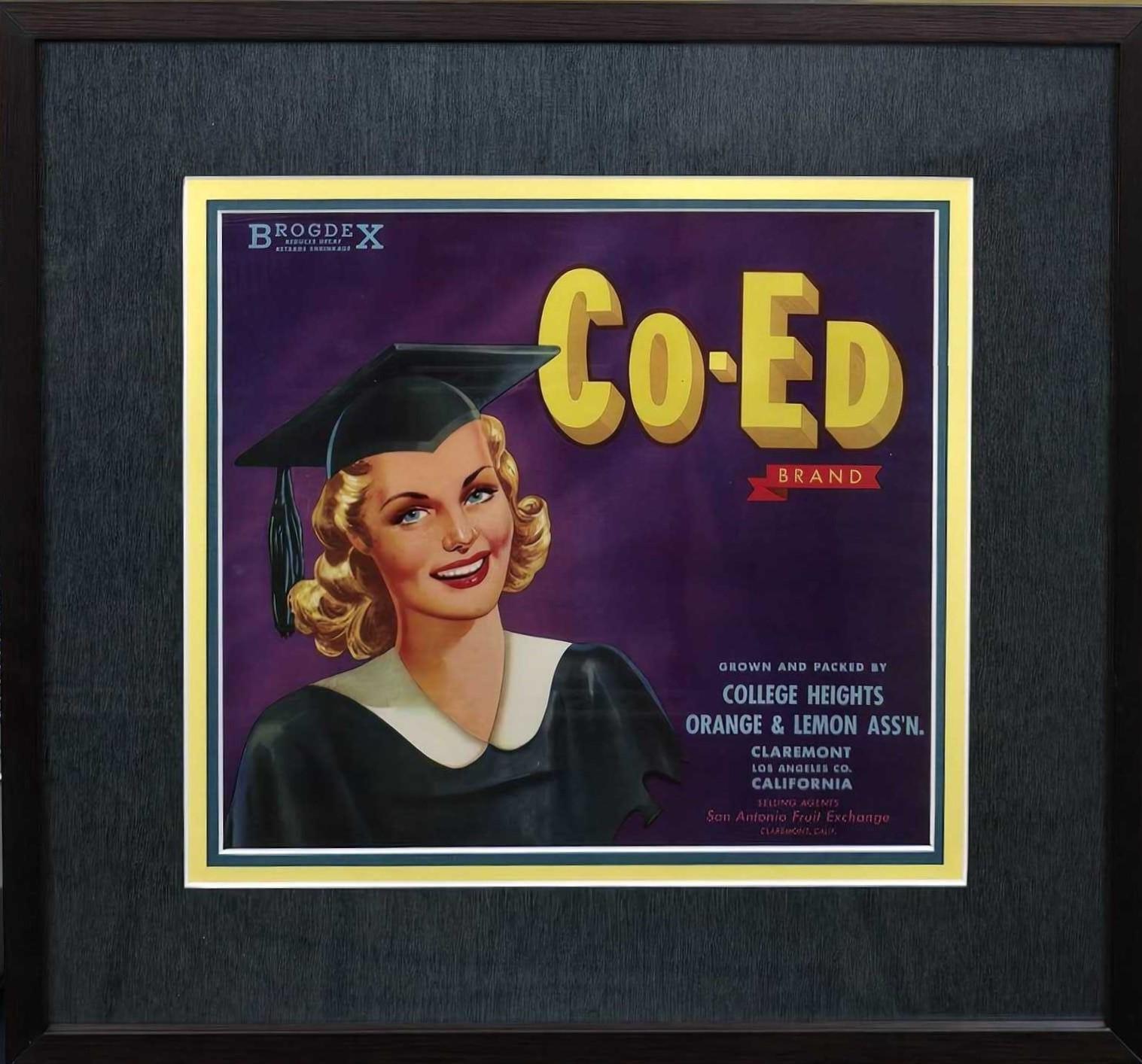

Co-Ed Brand Fruit Label c. 1940
Grown and Packed College Heights Orange and Lemon ASS’N Claremont Los Angeles Co., California
Selling Agents San Antonio Fruit Exchange Claremont Calif.
1. Geographic & Agricultural Background
- Precise Location: The College Heights district encompasses the northern and eastern parts of Claremont, Los Angeles County, California, situated at the foothills of the San Gabriel Mountains, approximately 30 miles east of downtown Los Angeles. Key areas include elevations around 1,200–1,500 feet near Pomona College (along Foothill Boulevard and Indian Hill Mesa) and extending toward the San Antonio Canyon wash, providing natural drainage and protection from coastal fogs.
- Soil and Water: Predominantly deep, fertile alluvial loam soils derived from San Antonio Canyon sediments, with excellent drainage and nutrient retention ideal for citrus root systems. Irrigation relied on artesian wells, mutual water companies like the San Antonio Water Company (established 1880s), and diverted flows from San Antonio Creek; early frost protection involved smudge pots (oil-burning heaters) and wind machines to circulate warmer air, critical during occasional freezes below 28°F.
- Role in the “Citrus Belt”: Claremont formed a core of Southern California’s “Citrus Belt” (1880s–1950s), with peak acreage reaching 3,000–4,000 acres of oranges and lemons by 1950, contributing to the region’s 80% share of U.S. citrus output. The area’s arrival of the Santa Fe Railroad in 1887 spurred rapid expansion, but post-WWII suburbanization (e.g., housing tracts replacing groves) led to a sharp decline by the 1960s, shifting production eastward to Riverside County.
2. History of CHO&LA and the Co-Ed Brand
- Founding & Purpose: Incorporated in the early 1900s (records from 1900 onward) as a merger of the Claremont Lemon Association (est. 1890s) and College Heights Orange Association, evolving into the College Heights Orange and Lemon Association (CHO&LA) by 1910–1920 to pool resources among local growers for efficient harvesting, packing, and marketing amid volatile prices and high shipping costs. Original members included professors, alumni, and family farmers tied to Pomona College, emphasizing quality control for premium fresh-market fruit.
- Evolution & Key Milestones:
- 1922: Construction of the iconic lemon packing house at 532 W. First Street (concrete-block and wood structure along Santa Fe tracks) for washing, grading, and storage; an adjacent orange packing house operated nearby.
- 1930s–1940s: Introduction of Brogdex wax coating to prevent mold during rail shipments; peak operations with multiple brands and Sunkist affiliation boosting exports.
- 1950s: Membership growth to over 100 growers; facility upgrades for mechanical sizing, but freezes (e.g., 1950s events) and smog damage strained operations.
- 1965: Packed ~1 million boxes of lemons annually; encroaching urbanization reduced acreage.
- Dissolution timeline: Ceased packing operations in 1972 due to grove conversions to housing; assets sold, with the lemon house repurposed as a warehouse until adaptive reuse in the 2000s—no full merger or revival documented.
- Significance of “Co-Ed” Name: Evoked Pomona College’s co-educational status (one of the first in the West, est. 1887) and youthful, intellectual prestige; branding positioned citrus as “educated” premium fruit, appealing to East Coast buyers via college nostalgia and academic ties.
3. Business Structure & Relationships
- Legal Structure: Operated as a non-profit agricultural cooperative under California law, with member-growers (local families, professors, and alumni) holding shares based on acreage delivered; profits distributed proportionally after expenses, with democratic voting at annual meetings documented in ledgers (e.g., 1929 stock certificates).
- Packing Operations:
- Primary facility at 532 W. First Street, Claremont (lemon house: 100×100 ft. receiving/packing “T” addition); layout included pre-cooling rooms, grading lines, and rail sidings for direct loading.
- Capacity estimates: ~1 million boxes (lemons/oranges) per season by 1965; used early mechanical sizers (1930s) and Brogdex treatment lines for waxing to extend shelf life during cross-country rail hauls—no exact pre-1950 volumes publicly available.
- Selling Agent – San Antonio Fruit Exchange:
- Exclusive broker (Claremont-based, est. 1893 in Pomona as a district arm of the Southern California Fruit Exchange), handling sales on commission (~10–15% inferred from era norms); managed pricing, auctions, and logistics for standardized fruit.
- Distribution channels: Santa Fe and Union Pacific rails to Los Angeles wholesale terminals, then to Chicago markets, East Coast cities, and exports (Canada, UK, early Japan post-WWII).
- Industry Affiliations: Confirmed Sunkist member via California Fruit Growers Exchange (from 1905 onward), benefiting from collective advertising and by-products sales (e.g., oils via Exchange By-Products Co.); ties to Fruit Growers Supply Co. for crates/insecticides; rivalries with nearby independents like Upland Lemon Association or La Verne Heights, but collaborative on frost warnings.
4. Varieties & Branding
- Citrus Varieties Packed:
- Oranges: Primarily Washington Navel (early/mid-season, seedless for fresh eating) and Valencia (summer, dual fresh/juice use).
- Lemons: Eureka and Lisbon strains (year-round, high-volume for export).
- Specialty: Grapefruit (e.g., under Collegiate Brand); limited tangerines documented in ledgers—no blood oranges or exotics noted.
- Co-Ed Brand Label Analysis:
- Design elements: Full-color stone lithography (c. 1940s), featuring a smiling blond woman in mortarboard and graduation gown (bust view) symbolizing co-ed education; black background for contrast, with orange/lemon motifs and “Grown and Packed by…” text; artist Ted Clark (Western Lithograph Co., Los Angeles).
- Size variations: Standard 10×11″ for full crates; smaller versions for half-boxes or gift packs; some with “Sunkist Wrapped, Brogdex Fruit” stamps.
- Printing: Produced by Western Lithograph Co. or Schmidt Litho. Co. (L.A.), emphasizing vibrant reds/oranges for shelf appeal.
- Marketing Strategy: Leveraged college themes for premium pricing (e.g., gift shipments to alumni); advertised in Pomona College magazines, railroad promotions, and Sunkist campaigns; positioned as “youthful and superior” for urban markets.
- Collectibility: Highly sought by label enthusiasts; original 1940s lithos auction for $50–$200, depending on condition: tears reduce value; rarer than offset prints; featured in collections like Oglesby Citrus Label Collection—no widespread fakes reported, but reproductions common.
5. Culture & Community Impact
- Grower & Labor Culture:
- Blend of academic growers (Pomona professors/alumni managing small orchards) and Japanese-American families (pre-WWII, many interned 1942–1945, leading to labor shortages); post-war, relied on bracero program (Mexican guest workers) and student hires from colleges.
- Seasonal rhythms: Fall harvests with community barbecues; winter frost watches using smudge pots, fostering cooperative bonds via weekly meetings.
- Community Identity:
- Packing house as social hub: Dances, grower meetings, and student jobs (e.g., Pomona undergrads packing during breaks); “Co-Ed” brand as Claremont’s citrus mascot, tying industry to college prestige (e.g., fruit sales at football games).
- Economic backbone: Employed ~1/3 of workforce in 1920s; funded local infrastructure via co-op dividends.
- Legacy & Preservation:
- Site now adaptive reuse (532 W. First St.): Mixed-use with restaurants, lofts, and Claremont Forum—no historic marker on building, but listed in LA Conservancy tours.
- Oral histories in Claremont Heritage/Pomona College archives capture grower stories; photos show packed crates and workers; influences modern branding (e.g., citrus motifs in Village walkways, Pitzer College seal with orange tree).
6. Official & Reliable Sources
- Primary Archival Sources:
- Claremont Heritage – Packing house photos, oral histories, and citrus timelines; contact for tours (909-621-0848).
- Pomona College Archives – CHO&LA ledgers, alumni orchard maps, and stock certificates (Honnold-Mudd Library, specialcollections@claremont.edu).
- Los Angeles Public Library Citrus Label Collection – High-res scans of Co-Ed and Collegiate labels.
- Crate Label Databases:
- TheCitrusLabelGallery.com – Co-Ed images and artist attributions.
- FruitCrateArt.com – Auction listings and rarity ratings.
- Historical Publications:
- Claremont: A Pictorial History (J. Brown, 1980s) – Detailed CHO&LA chapter.
- Sunkist annual reports (via HathiTrust or Hoover Institution) – District exchanges 1915–1950.
- USDA Citrus Reports (1920s–1950s) via NAL USDA – Claremont production stats (no CHO&LA specifics).
- Local Media:
- Claremont Courier archives (Claremont Library microfilm) – Packing closures and grower interviews.
- California Citrograph (1915–1950) – San Antonio Fruit Exchange ads and tech updates.
- Note on Gaps: No confirmed exact founding date (pre-1900 records sparse) or detailed commission structures for San Antonio Exchange; artist Ted Clark unverified beyond labels.
Tessa, the Digital Collections of the Los Angeles Public Library

Reviews
There are no reviews yet.