22 Inches x 14 Inches
LEASE ONLY
-
AVAILABLE FOR MATTING & FRAMING
-
GUARANTEED ORIGINAL
22 Inches x 14 Inches
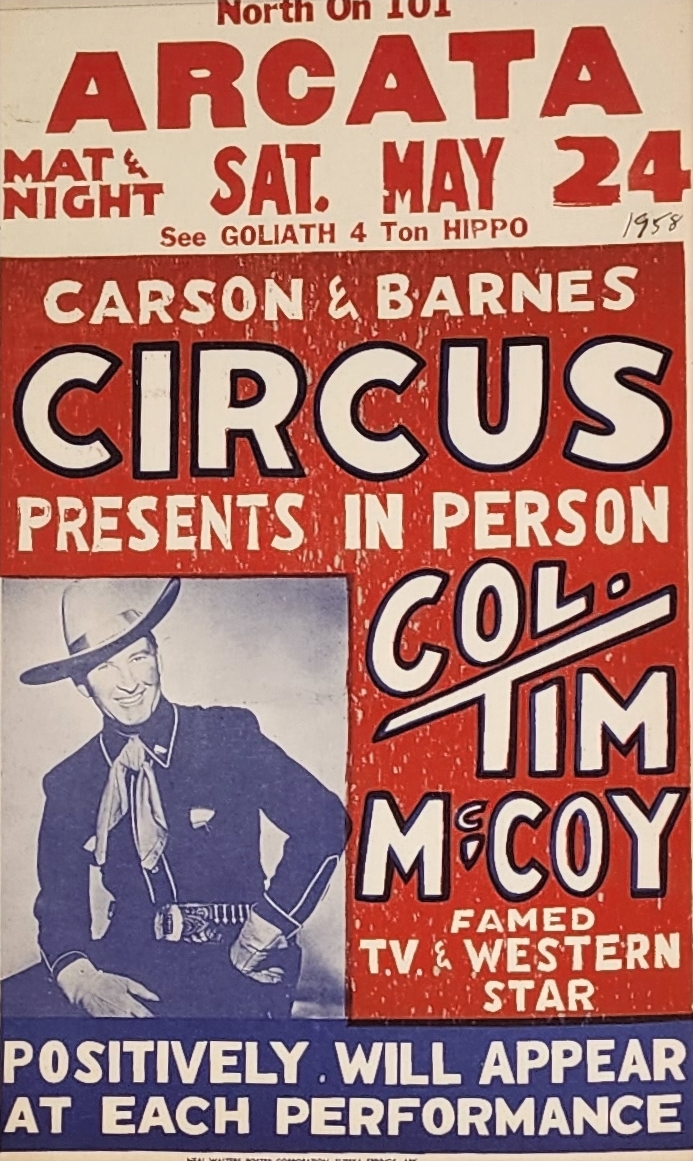
Colonel Tim McCoy (1891–1978), a pioneering Western film star known for over 100 B-movies in the 1920s–1940s (e.g., The Fighting Fool, 1932) and his authentic portrayal of cowboys learned from Cheyenne reservation friendships, transitioned to live performance in the 1930s amid Hollywood’s decline. Commissioned as a Wyoming cavalry colonel in 1927, McCoy leveraged his “Col.” title for credibility, touring with Ringling Bros. and Barnum & Bailey in 1936–1937 as a Wild West headliner, complete with roping, sharpshooting, and historical reenactments like Custer’s Last Stand. His 1938 solo “Col. Tim McCoy’s Real Wild West” folded after a month due to costs, but he revived Wild West elements in circuses for steady work.
The Carson & Barnes Circus, a family-run tent show tracing to Obert Miller’s 1937 “dog and pony” in Kansas, rebranded from Tex Carson Circus (post-1950s acquisition by D.R. Miller from Jack and Angela Moore) to Carson & Barnes in 1958 for rhythmic appeal, wintering in Hugo, OK. By 1958, under Moore’s ownership, it was a modest one-ring operation with animals, clowns, and acrobats, touring Midwest/West fairs. McCoy joined as feature act that season, entering on a white horse for a 10–15-minute finale: hippodrome laps, kneeling mount, whip tricks (e.g., popping bottle caps), roping, gun slinging, Native reenactments (using sign language in three tongues), and storytelling on cowboys/Indians—drawing 1,000–2,000 per stand at 50–75¢ tickets. Perks included a yellow Mercury and trailer; the “family feel” endeared him to crew like the Moyers. McCoy’s draw boosted attendance amid TV rivalry, but he retired post-1958; Carson & Barnes grew to 5-rings by 1960s under Millers/Byrds, folding in 2023 after 85 years. The window card, ca. 1958–1959, promoted McCoy’s act for shop displays, tying his stardom to the show’s “Real Wild West” annex.
The “Col. Tim McCoy – Carson & Barnes Circus” window card, a compact 14×22-inch cardstock promo from ca. 1958 printed by regional offsets like Enquirer Job Print Co. (Cincinnati), captured late-1950s vernacular graphics’ star-powered simplicity, tailored for urban storefront tacks to funnel crowds to tent lots. Vibrant primaries dominated—fiery reds for Western dust, sunny yellows for hero’s hatband, deep indigos for twilight skies—against a white field for street readability, evoking faded film posters with folk-art flair. Central portraiture spotlighted McCoy in iconic pose: stern-jawed profile or three-quarter view, Stetson tipped, chaps buckled, lasso coiled over fringed shirt, rendered in semi-photorealistic halftone with exaggerated jawline and piercing eyes for mythic gravitas; faint vignettes of rearing horse, teepees, or stagecoach chase framed him, nodding to Wild West chaos without cluttering the format.
Typography was punchy and promotional: bold sans-serif arched headline in 2-inch caps—”COL. TIM McCOY – SCREEN’S GREATEST WESTERN STAR AT CARSON & BARNES CIRCUS!”—in red-outlined yellow, undercut by script hooks like “Thrilling Wild West! Roping – Riding – Reenactments!” and a bottom strip for dates/prices (e.g., “Hugo, OK – June 15 – 50¢ Adm.”). Echoing 1930s Erie Litho templates from his Ringling days, the design layered Hollywood gloss (star billing) with circus thrift—tack holes, creases, and corner wear from display adding patina. This approachable style bridged B-Western nostalgia with big-top accessibility, masking modest production.
The McCoy window card epitomized the 1950s circus as a celluloid-cowboy lifeline—a bridge from silver-screen myths to sawdust rings, where fading matinee idols like McCoy revived frontier folklore for postwar families grappling with suburban sameness and Cold War jitters. Amid TV Westerns (Gunsmoke, 1955), his act—authentic sign language, balanced Native portrayals—offered “real” escapism, romanticizing the West as egalitarian saga while glossing erasure (e.g., sanitized Custer tales), fostering communal lore at rural fairs where vets and kids mingled in lassoed wonder. As vernacular icon, it humanized celebrity nomadism, influencing nostalgia revues (Annie Get Your Gun) and ethical reckonings on Wild West tropes amid #LandBack. Today, post-2023 Carson closure, it evokes poignant hybridity—Hollywood grit meets tent grit—inspiring decolonial retellings like Reservation Dogs.
Carson & Barnes Circus Company, a Miller family proprietorship (D.R. Miller post-1950s, later Barbara/Geary Byrd), produced the card from Hugo, OK, quarters for the 1958 tour: a single-ring big top via trucks for 80–100 Midwest stands, 2-hour programs with McCoy’s finale amid animals/clowns, 50–75 crew on $20,000–$30,000 budgets offset by tickets/concessions. McCoy, contracted at $1,000–$2,000 weekly with perks, rehearsed roping/guns in winter; his white horse and props (whip, pistols) integrated via Moore’s scouts. Window cards, for merchant displays to spike attendance, printed in 200–300 runs by Enquirer using two-color offsets for economy; advance agents tacked them 1–2 weeks out, customizing with stamps. This McCoy variant hyped “star power” amid TV threats, with Native collaborators for authenticity.
Archival Sources:
The Col. Tim McCoy event featured on a Carson and Barnes Circus poster refers to a specific period in the circus’s touring history when McCoy, a former silent film star and well-known Wild West showman, was billed as a headlining attraction. Likely occurring in the 1950s, this collaboration capitalized on McCoy’s celebrity status from Western films and his earlier involvement with Wild West exhibitions, which were precursors to the modern circus. His inclusion in the Carson and Barnes lineup was part of a broader trend among mid-20th-century circuses to incorporate well-known personalities to boost attendance and appeal to audiences familiar with radio, film, and television. Posters advertising McCoy’s appearance often emphasized his military title, film career, and frontier persona, blending circus tradition with popular entertainment culture. This crossover reflects the evolving strategies circuses used to remain relevant and competitive in an era of changing public tastes.
| Weight | 1 lbs |
|---|---|
| Dimensions | 22 × 14 in |
| Window Card | 22 inches tall by 14 inches wide |

Reviews
There are no reviews yet.