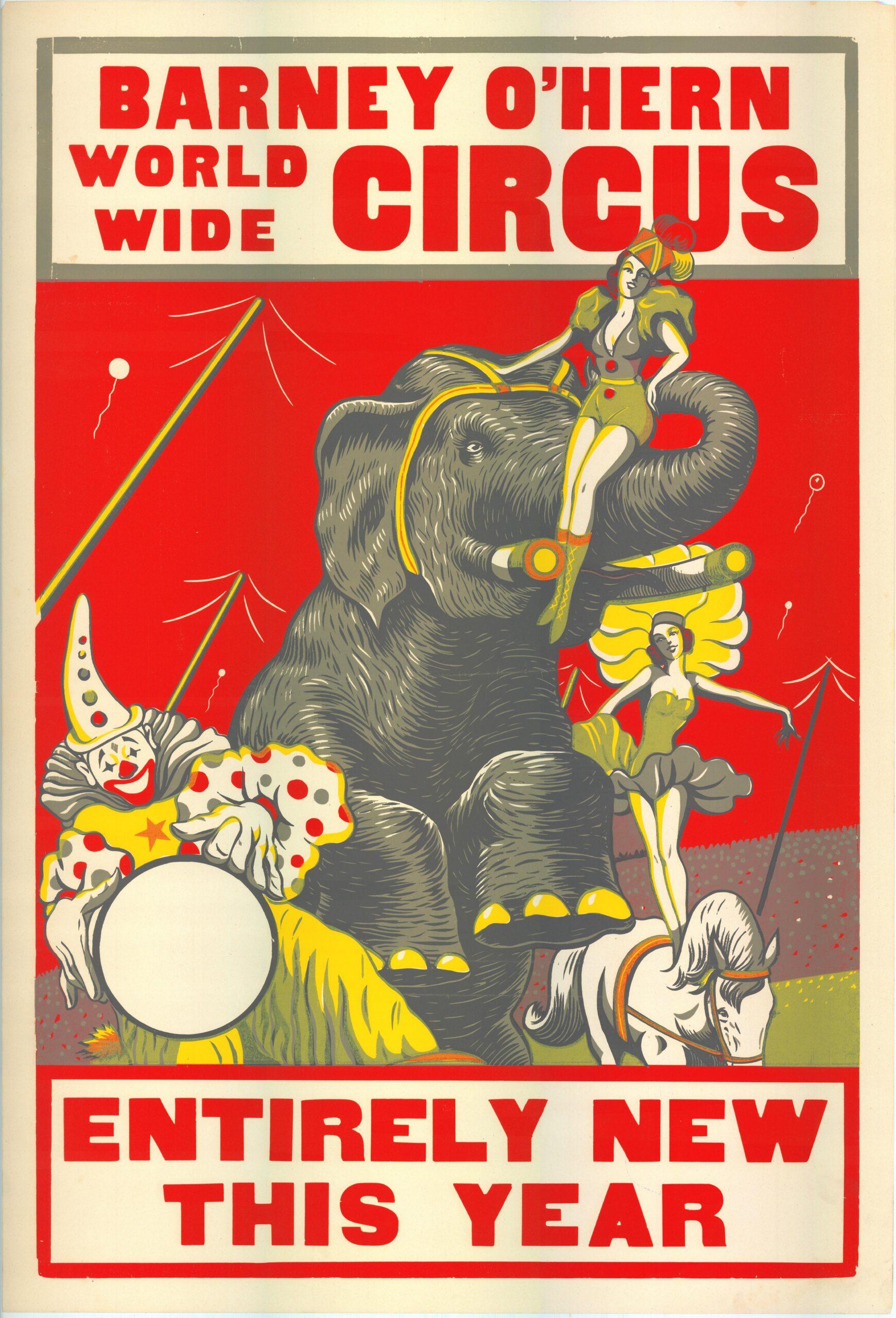
Barney O’Hern Circus Poster with Clown, Showgirl & Elephant
History
The Barney O’Hern Circus, known fully as Barney O’Hern’s World Wide Circus, was a brief postwar American tent show that operated only during the 1946 season, emerging amid a surge in demand for live family entertainment as the nation rebuilt from World War II. Founded by Barney O’Hern, a veteran showman with roots in vaudeville, carnival concessions, and sideshow management for established circuses like Hagenbeck-Wallace, the operation was designed as a modest one-ring spectacle to bring affordable thrills to rural and small-town audiences in the Midwest and Northeast. O’Hern, active in the industry since the 1920s, assembled a compact troupe featuring equestrians, wire walkers, trained animals (dogs, ponies, and a single elephant for parades), clowns for comic relief, and showgirls for glamorous accents. The circus toured roughly 40–50 dates across states including Ohio, Pennsylvania, New York, and Illinois, often in partnership with county fairs, VFW halls, and community lots under a refurbished big top seating 800–1,000. Postwar challenges—such as fuel scarcity, labor shortages from returning GIs, equipment issues, and emerging media like radio and television—hastened its end; O’Hern liquidated assets to pay debts and returned to carnival work. This “one-season wonder” exemplifies the gritty resilience of independent “mud shows.” The “Barney O’Hern Circus Poster with Clown, Showgirl & Elephant” is a promotional half-sheet from this tour, likely customized for stops like the Summit County Fair, highlighting the show’s eclectic acts to entice families with promises of laughter, elegance, and exoticism.
Design
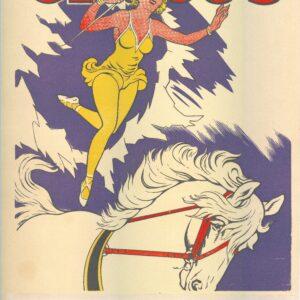
Barney O’Hern posters, including the clown-showgirl-elephant variant, embodied the vibrant, cost-conscious offset lithography of the late 1940s, optimized for striking visibility on rural fences and barns while keeping production simple. Printed as portable half-sheets (21×28 inches) on durable, weatherproof stock, they featured a bold palette of primaries—crimson reds for energy, golden yellows for cheer, and slate grays for the elephant’s mass—set against a crisp white backdrop to cut through haze. The composition revolved around a lively central tableau: a flamboyant clown in polka-dotted garb mid-tumble with exaggerated grin and props, a radiant showgirl in feathered headdress and sequined attire striking a poised pose, and a towering elephant rearing with trunk aloft, trunk curling toward the showgirl in a gesture of mock salute; faint tent stripes and acrobat silhouettes in the rear evoked the full spectacle. Typography dominated with arched, sans-serif block letters spelling “BARNEY O’HERN WORLD WIDE CIRCUS” in commanding caps, paired with curly script for hooks like “Hilarious Hijinks! Dazzling Divas! Colossal Critters!” and a detachable bottom strip for local details (e.g., “Scranton, PA – Sept. 10 – 35¢ Kids”). The clown’s caricature nodded to hobo styles like Emmett Kelly’s, the showgirl echoed pin-up glamour, and the elephant’s detailed wrinkles suggested borrowed exoticism—all unified in a whimsical, motion-blurred style bridging wartime propaganda’s optimism with circus fantasy. Handling marks like folds and smudges enhanced their lived-in authenticity.
Cultural Significance
Barney O’Hern’s posters, particularly the clown-showgirl-elephant trio, encapsulated the circus as a postwar tonic—a roving carnival of catharsis that mended social rifts in America’s agrarian core, offering a canvas for collective wonder amid demobilization and domestic rebirth. In 1946, these images invoked timeless archetypes: the clown as chaotic everyman channeling wartime absurdities into belly laughs, the showgirl as emblem of reclaimed femininity and allure post-Rosie era, and the elephant as behemoth of imperial adventure subdued for delight, collectively weaving escapism from the threads of rationed dreams. The show itself acted as itinerant hearth, drawing factory hands, veterans, and youth into egalitarian revelry under canvas, sustaining Barnum-esque folklore on a grassroots level while foreshadowing the “mud show” fade against mass entertainment. As artifacts of vernacular exuberance, they influenced mid-century graphics and variety revivals, subtly critiquing (or glossing) gender tropes and animal agency in spectacle. Today, they kindle tender nostalgia for ephemera in a streaming age, inspiring ethical reinterpretations in modern circuses like Cirque du Soleil and fueling dialogues on heritage amid animal-free shifts, as seen in post-Ringling reflections.
Production and the Company Behind It
Barney O’Hern’s World Wide Circus ran as a lean proprietorship under Barney O’Hern’s Pittsburgh oversight, bootstrapped on a $4,000–$6,000 budget with prep in leased winter lots. Infrastructure centered on a 60-foot single-ring tent salvaged from 1930s closures, an 8-act program mixing O’Hern family (his wife on wires) with hired talent, and a 20-person roustabout crew handling everything from staking to concessions. The clown anchored slapstick segues, the showgirl lent sparkle in horse- or elephant-adjacent routines, and the elephant—a rented menagerie asset—performed basic lifts and parades under gentle cues for the 85-minute show. Posters emerged in runs of 200–300 from regional offset printers like Cincinnati’s Enquirer Job Print Co. or Pittsburgh locals, using two- to three-color processes for haste and thrift; designs adapted 1930s stock illustrations (clown gags, showgirl poses, elephant profiles), branded with O’Hern’s flair and routed by advance scouts for wheat-paste application two weeks pre-show. This variant spotlighted the “triple-threat” for broad appeal, with minimal animal training prioritizing safety. Unsold prints were discarded post-season, boosting rarity.
Relevant Archival Sources and Modern Interest in Such Labels
Archival Sources:
- John and Mable Ringling Museum of Art (Sarasota, FL): Maintains the eMuseum collection with Barney O’Hern ephemera, including “Barney O’Hern: Clown with Equestrienne” posters and related 1940s independents; searchable for clown-showgirl motifs alongside elephant vignettes.
- Library of Congress Prints & Photographs Division (Washington, DC): Hosts the Circus, Carnival, and Rodeo Poster Collection (ca. 500 items, 1840–1950), encompassing analogous 1940s lithographs with clown-elephant-showgirl elements; includes folklife recordings on postwar showmen.
- Princeton University Library Miscellaneous Circus Collection (Princeton, NJ): Features subject files on 1940s acts, including posters, broadsides, and clippings for independents like O’Hern; covers clowns, showgirls, and elephants in ephemera folders.
- Circus World Museum (Baraboo, WI): Archives 1946 route cards and poster fragments in the Robert L. Parkinson Collection; digital portal aids research on one-season ventures with animal-clown integrations.
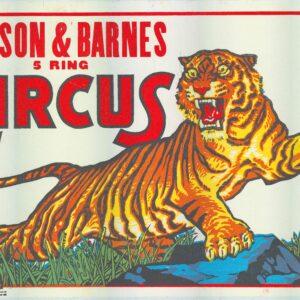
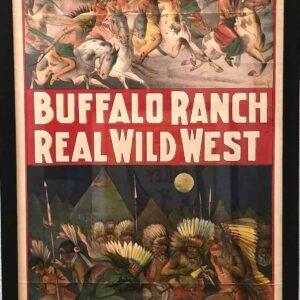
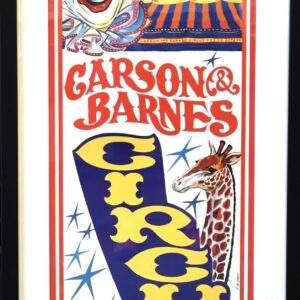
This authentic one-sheet upright poster (42 inches tall by 28 inches wide) was printed for the Barney O’Hern Circus of 1946. The Barney O’Hern circus was started as a truck circus in the months immediately following World War II, and while it closed shortly after it opened, the posters for this show were quite attractive, indicative of 1940s circus art, and are highly collectible.
Reviews
There are no reviews yet.