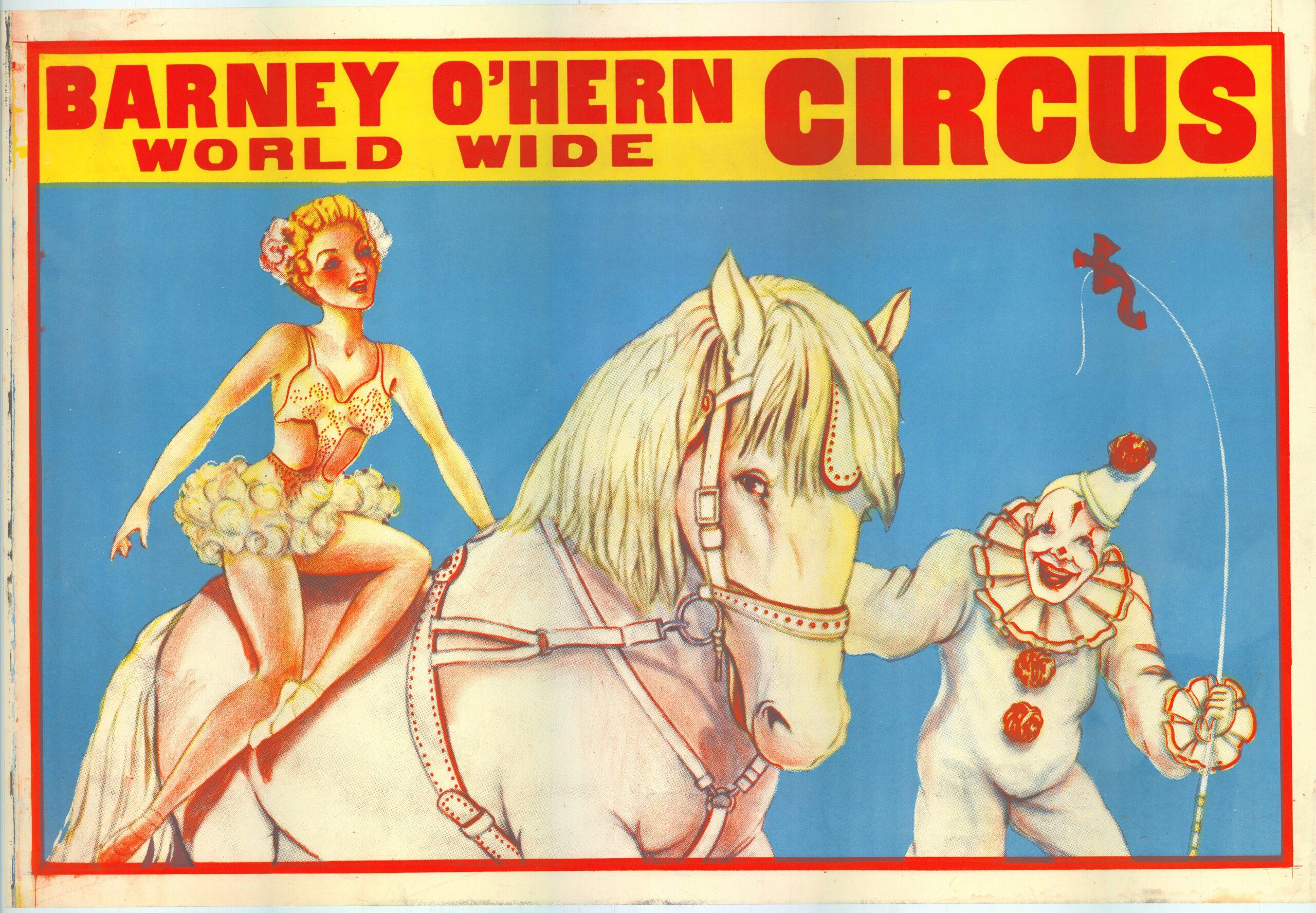
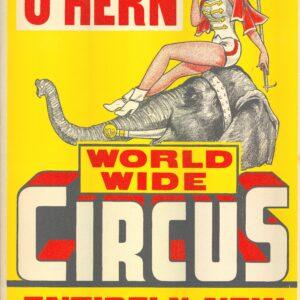
Barney O’Hern Circus Poster with Showgirl, Horse and Clown
History
The Barney O’Hern Circus, officially Barney O’Hern’s World Wide Circus, was a fleeting postwar American tent show that operated solely during the 1946 season, capitalizing on the renewed appetite for live entertainment in the wake of World War II. Founded by Barney O’Hern, a seasoned showman with a background in vaudeville, carnival sideshows, and concessions for larger circuses like Hagenbeck-Wallace, the operation was conceived as a modest one-ring affair to deliver affordable thrills to Midwestern and Northeastern rural communities. O’Hern, who had honed his skills in the 1920s and 1930s as a promoter and performer, assembled a lean troupe of equestrians, wire walkers, trained animal acts (primarily dogs and ponies), and novelty performers, including showgirls for glamorous vignettes. The circus toured approximately 40–50 dates across states such as Ohio, Pennsylvania, New York, and Illinois, often aligning with county fairs, VFW events, and community lots, under a big top tent seating 800–1,000 spectators. Economic headwinds—including gasoline rationing echoes, labor shortages from returning veterans, and competition from radio broadcasts and nascent television—coupled with logistical strains like equipment breakdowns, led to its swift dissolution at season’s close. O’Hern auctioned off assets to settle debts and pivoted back to carnival work, rendering the show a quintessential “one-season wonder” in the annals of small-time circus history. The “Barney O’Hern Circus Poster with Showgirl, Horse and Clown” captures this ephemeral spirit, likely a variant from the tour’s promotional blitz, highlighting the show’s blend of glamour, equestrian prowess, and comic relief to draw crowds to stops like the Erie County Fair or Pittsburgh-area venues.
Design
The Barney O’Hern posters, including the variant featuring a showgirl, horse, and clown, exemplified the exuberant yet economical offset lithography of the late 1940s, designed for maximum roadside impact on a shoestring budget. Typically printed as half-sheets measuring 21×28 inches for portability, they utilized a punchy color scheme of bold primaries—scarlet reds for drama, golden yellows for warmth, and deep indigos for contrast—on matte stock paper to withstand weather during barn and fence postings. The composition centered on a dynamic tableau: a statuesque showgirl in a feathered headdress and sequined gown poised elegantly beside a rearing horse, symbolizing grace and power, while a grinning clown in polka-dotted attire tumbles comically at the base, injecting whimsy and accessibility. These elements framed the iconic big top tent in the background, evoking a sense of grand adventure scaled for small towns. Typography employed arched, sans-serif block letters for the headline “BARNEY O’HERN WORLD WIDE CIRCUS” in oversized caps, with playful script for taglines like “Glamour! Gallops! Guffaws!” and a customizable lower strip for local dates and admission prices (often 25–50 cents). The horse was rendered in fluid, almost Art Deco lines to suggest motion, the showgirl with idealized pin-up flair reminiscent of wartime posters, and the clown in exaggerated caricature akin to Emmett Kelly’s hobo style—blending aspiration with levity. Fold marks and minor creases from advance-man handling added to their authentic, battle-worn charm, reflecting a transitional postwar aesthetic that bridged Depression-era frugality with emerging consumer optimism.
Cultural Significance
Barney O’Hern’s posters, particularly those spotlighting the showgirl-horse-clown triad, embodied the circus as a vital postwar balm for America’s heartland—a mobile festival of fantasy that briefly suspended the scars of global conflict and economic austerity. In 1946, as GIs reintegrated and families sought normalcy, these visuals promised escapism through archetypal figures: the showgirl as emblem of feminine allure and resilience, the horse as symbol of untamed freedom tamed for spectacle, and the clown as everyman jester diffusing tension with absurdity. The show itself reinforced communal rituals, transforming dusty fairgrounds into egalitarian melting pots where farmers, factory workers, and children mingled under canvas, fostering oral traditions of wonder that echoed P.T. Barnum’s legacy but on a hyper-local scale. As a microcosm of the “mud show” era—gritty, itinerant outfits that predated animal-rights reckonings and corporate arenas—these artifacts highlight the democratizing power of live performance in pre-mass-media America, influencing later cultural touchstones like The Greatest Showman or folk revivals of big-top lore. Today, they evoke a poignant nostalgia for impermanence, underscoring how such promotions once stitched social fabrics amid transition, while inviting critique of the era’s gender roles and animal use in entertainment.
Production and the Company Behind It
Barney O’Hern’s World Wide Circus operated as a family proprietorship under Barney O’Hern’s direct oversight from makeshift winter quarters in Pittsburgh, Pennsylvania, emphasizing nimble, multifunctional production to launch on a reported $4,000–$6,000 budget. The core setup included a refurbished 60-foot single-ring big top acquired from defunct Depression-era shows, a 6–8 act lineup with O’Hern’s kin (his wife on wirewalking) alongside hired equestrians and animal trainers, and a 20-person crew of roustabouts who multitasked from rigging tents to hawking tickets. Showgirls provided visual flair in brief, choreographed routines atop horses, while clowns anchored comic interludes to pad the 90-minute program. Posters were churned out in batches of 200–400 by Midwestern offset printers like the Enquirer Job Print Company in Cincinnati or local Pittsburgh shops, using two- to three-color presses for rapid, low-cost output; designs drew from stock 1930s templates, customized with O’Hern’s motifs and routed via advance agents who wheat-pasted them two weeks pre-arrival. The showgirl-horse-clown variant targeted family appeal, with horses sourced from regional farms and trained minimally for safe parades. Post-season, surplus prints were discarded or repurposed, amplifying their scarcity.
Relevant Archival Sources and Modern Interest in Such Labels
Archival Sources:
- Circus World Museum (Baraboo, WI): Preserves 1940s independent circus ephemera, including O’Hern route cards and poster stubs in the Robert L. Parkinson Midwest Collection; digital access via the Wisconsin Historical Society portal for postwar show research.
- University of Iowa Libraries Special Collections (Iowa City, IA): Features Midwestern fair posters and programs in the Hake’s Americana & Collectibles Auction archives, with 1946 O’Hern references alongside photos of similar one-season operations.
- Library of Congress Prints & Photographs Division (Washington, DC): Holds comparable 1940s circus lithographs and folklife recordings from the American Folklife Center, capturing showmen interviews on postwar challenges.
- Bandwagon Magazine Archives (via Circus Fans Association of America): Indexes 1946 reviews and ads in digitized issues, detailing O’Hern’s acts including equestrian and clown routines.
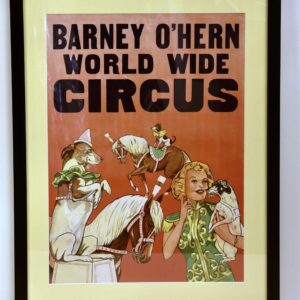
This authentic one-sheet upright poster (42 inches wide by 28 inches tall) was printed for the Barney O’Hern Circus of 1946. The Barney O’Hern circus was started as a truck circus in the months immediately following World War II, and while it closed shortly after it opened, the posters for this show were quite attractive, indicative of 1940s circus art, and are highly collectible.
Reviews
There are no reviews yet.