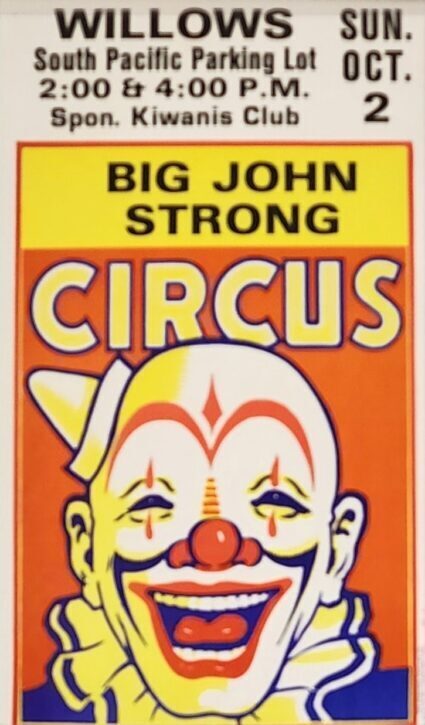
Big John Strong Circus (Window Card)
History
The Big John Strong Circus, a beloved family-operated tent show, was founded in 1948 by John A. “Big John” Strong in Hollywood, California, beginning modestly as a literal “dog and pony” operation with just one of each animal, performing at backyard parties for Strong’s film industry friends. Standing at 6’5″ (nearly 7′ in his signature top hat), Strong—a former mattress salesman and aspiring actor with ties to Lucille Ball—embodied the larger-than-life showman ethos, earning the moniker “the man with more friends than Santa Claus” for his affable charisma and business acumen. His wife, Ruth Strong (dubbed “the first lady of the circus”), handled animal training, starting with ponies and dogs before expanding to elephants like Neena (born wild in 1963, the third of her name in the show). By 1954, growth necessitated winter quarters on several acres in Thousand Oaks, CA, near Jungleland USA, where the family (including adopted daughters Sandy and Linda, and son John Jr.) integrated circus life with Hollywood flair—elephants for show-and-tell, a two-nosed cow as a novelty.
The circus evolved into a full one-ring tent operation by the 1960s, touring primarily the Western U.S. (California, Nevada, Arizona) with 80–100 seasonal stands at fairs, schools, and lots, seating 1,000–2,000 under a 60–80-foot big top. Acts included clowns (e.g., Poco the Clown with comedy cars and juggling), acrobats, wire walkers, a sideshow with oddities, and animal routines (elephant parades, dog leaps), often sponsored by groups like Jaycees or Fraternal Order of Police. Strong’s philosophy—”operate a good, clean show”—fostered loyalty; alumni recall his generosity, like funding employee weddings. It peaked in the 1970s with nationwide reach (e.g., New York, Kentucky), but rising regulations, costs, and a 1982 lawsuit over an employee’s fatal accident forced Strong to sell; he passed in 1993, buried in Hugo, OK’s Showman’s Rest. Son John Jr. continued with a sideshow/museum until the 2000s; Ruth died in 2010. The window card, a smaller poster for shop displays (ca. 1970s–1980s), promoted local stands like Glasgow, KY’s July 4th event, capturing the show’s community roots amid TV’s encroachment.
Design
Big John Strong Circus window cards, typically 14×22 inches for easy window mounting, reflected 1970s–1980s offset printing’s playful vernacular style, blending folk-art whimsy with bold roadside appeal to hype family-friendly fun. Printed on cardstock by Enquirer Printing Co. (Cincinnati, OH) or similar regional firms, they popped with primaries—vibrant reds and yellows for energy, electric blues for tents, blacks for outlines—against white grounds for legibility from streets. The Glasgow, KY example (n.d., sponsored by Fraternal Order of Police) centered three cartoonish clowns in exaggerated poses—bulbous noses, polka-dot suits, one juggling pies, another slipping on a banana peel—framed by faint big top stripes and elephant trunks, evoking slapstick chaos without overwhelming the compact format.
Typography was hierarchical and festive: arched sans-serif headlines in 2–3-inch caps blared “BIG JOHN STRONG CIRCUS” in red-outlined yellow, with script subheads like “Thrills! Laughs! Amazing Acts!” and a bottom panel for dates/locations (e.g., “July 4th – Central Center Shopping Center – 2 Shows Daily”). Influenced by 1950s mud show templates, designs prioritized humor over hyperbole—clowns as approachable stars, subtle animal nods for kid appeal—with tack holes, creases, and edge wear from shop use adding patina. This unpretentious aesthetic mirrored the show’s “clean, welcoming” vibe, contrasting corporate spectacles like Ringling.
Cultural Significance
The Big John Strong Circus window card encapsulated the twilight of America’s independent tent circuses—a grassroots antidote to 1970s malaise, where clownish whimsy offered escapist camaraderie for blue-collar towns amid economic stagnation and media saturation. In an era of Vietnam scars and suburban sprawl, Strong’s operation—family-led, community-sponsored—embodied resilient Americana: clowns as everyman jesters diffusing anxiety, elephants as symbols of gentle wonder, fostering intergenerational bonds at dusty lots where locals bartered stories over popcorn. As a “clean show” outlier, it humanized the big top’s nomadic grit, influencing nostalgia media (The Greatest Showman, 2017) while glossing rigors like animal travel and performer nomadism, prefiguring 1980s welfare reforms. Strong’s legacy—philanthropy, loyalty—elevated it beyond commerce, a touchstone for “mud show” folklore. Today, post-2017 Ringling closure, the card evokes poignant impermanence, inspiring ethical revivals (e.g., Cirque du Soleil homages) and dialogues on heritage amid urban-rural divides.
Production and the Company Behind It
The Big John Strong Circus was a family proprietorship under John A. Strong, wintering in Thousand Oaks, CA (1960s–1980s), with Ruth managing animals and John Jr. assisting concessions. Production focused on mobility: a single-ring big top via 10–15 trucks for 2-hour programs (clowns, acrobats, elephant rides, dog acts), 50–75 crew (family plus hires like Poco the Clown), on $20,000–$40,000 budgets offset by 50¢–$2 tickets and Jaycee sponsorships. Animals (3–5 elephants, ponies, dogs) trained reward-based at quarters; advance agents pasted materials 1–2 weeks out.
Window cards, for shop windows to boost urban foot traffic, printed in 200–400 runs by Enquirer Printing Co. using two- to three-color offsets for thrift; designs adapted stock clown motifs, customized with sponsors/routes via stamps. The Glasgow variant (ca. 1970s) targeted holiday crowds, emphasizing “family fun” amid 1980s regulations signaling decline.
Relevant Archival Sources and Modern Interest in Such Labels
Archival Sources:
- Circuses and Sideshows Website (circusesandsideshows.com): Extensive digital archive of Big John Strong history, including photos, posters (e.g., 1970s window cards), and alumni stories; searchable for routes and acts.
- San Diego State University Special Collections (archives.sdsu.edu): John Strong Circus folder (1971) in San Diego Junior Chamber of Commerce Records (MS-0042), with programs, tickets, and sponsorship docs; aids Western tour research.
- Western Kentucky University Digital Commons (digitalcommons.wku.edu): Broadside collection holds the Glasgow, KY window card (n.d.), with metadata on clown illustrations and police sponsorship; open-access scans.
- The Circus Blog (thecircusblog.com): Oral histories and alumni posts (e.g., 1970s–1980s memories), including slide shows and ephemera scans; community-driven for personal narratives.
This Big John Strong Circus window card poster reflects the legacy of small, independent circuses that thrived in mid-20th century America, bringing live entertainment to towns often overlooked by larger shows. Operating primarily from the 1940s through the 1980s, Big John Strong’s circus was known for its one-ring format and emphasis on close-up performances, contrasting with the grand scale of three-ring productions. The poster served as a primary means of local advertising, typically displayed in shop windows and public gathering places to announce upcoming shows. It captures a period when the American circus was both a cultural staple and a mobile spectacle, with posters like this playing a vital role in building anticipation and drawing crowds in an era before digital media.
Reviews
There are no reviews yet.