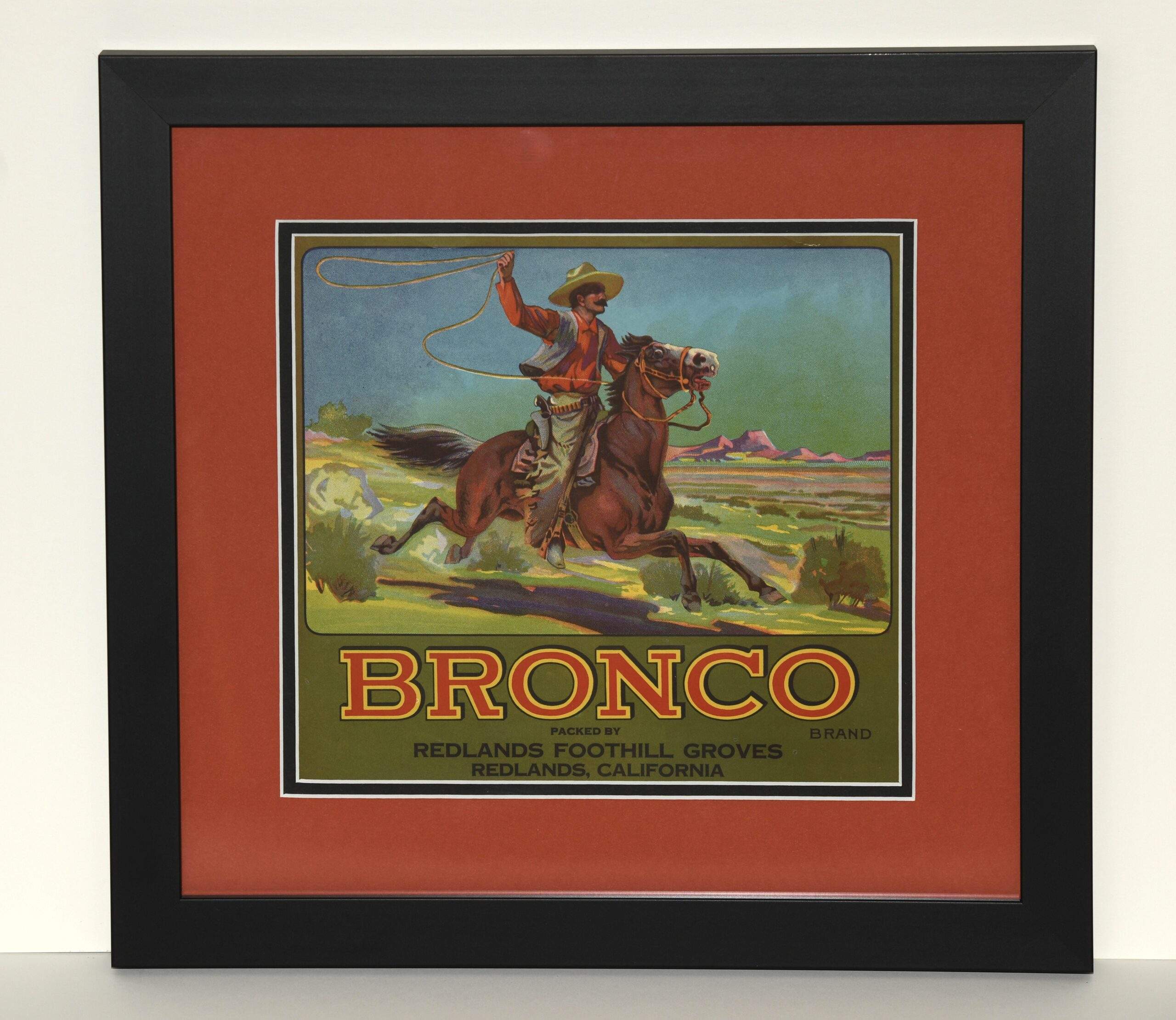

Bronco Brand Fruit Label c. 1920
The Bronco Brand label was produced primarily from the 1920s to the 1940s, with a documented print run in January 1949 by Western Litho Co., aligning with the broader peak of California’s citrus crate labeling era (circa 1900–1950), before the shift to pre-printed cardboard boxes post-World War II.
The label’s vibrant lithography, bold colors, dynamic typography, and Western cowboy-on-horse imagery with a lasso are hallmarks of interwar and post-war designs from Los Angeles-based printers like Western Litho Co. Archival collections date primary usage to 1920–1929, with the 1949 print reflecting extended production during wartime material constraints. Earlier variants (e.g., circa 1890–1900 by Mutual Label & Litho. Co. for California Citrus Union) exist, but the Redlands Foothill Groves version is tied to 1920s–1940s; uncertainties include minor design variations across runs, though no evidence suggests pre-1920 or post-1950s production for this iteration.
The label emerged in Redlands, a cornerstone of California’s citrus boom since the 1880s, driven by navel orange introductions, irrigation innovations, and refrigerated rail cars for nationwide shipping. It branded crates to differentiate produce in competitive markets, supporting California’s 70% U.S. orange production share by 1940; Redlands had over two dozen packinghouses in the 1930s, shipping millions of crates yearly.
Founded in 1924 by seven local growers who acquired the Strait packinghouse at Redlands Boulevard and 6th Street, the cooperative centralized sorting, washing, and shipping, introducing waxing for extended shelf life. It relocated to 304 Ninth Street in 1948, sustaining operations through the Great Depression and WWII (when citrus demand spiked for vitamin C). By the 2010s, it was San Bernardino County’s last operating packinghouse, sourcing from Central California and Arizona.
1920s rail expansions fueled exports, but WWII rationing hastened wooden crate decline. In 2024, Redlands Unified School District acquired the site for $12.3 million; as of September 2025, it’s repurposing into district headquarters, including Child Nutrition Services, with employee tours held August 5, 2025, and Phase I renovations ongoing (e.g., surveying contracted January 9, 2024, for $25,000).
The label’s depiction of a cowboy riding a horse and twirling a lasso against a desert or green plain backdrop uses lively lithographic illustration to evoke untamed Western energy, blending realism with adventure—typical of 1920s–1940s designs that doubled as “postcards” promoting California’s allure.
Tied to Southern California’s Inland Empire ranching heritage (from Spanish land grants to Anglo agriculture), it symbolizes Manifest Destiny, rural independence, and frontier myths amid urbanization. The bronco motif taps into cowboy culture as a “way of life” connecting to land and animals, reflecting nostalgia for simpler times via Western films and rodeos, while marketing “exotic” sun-ripened citrus to urban Easterners during economic hardships like the Depression.
These labels preserve Americana, appearing in exhibits on migration, innovation, and Western promotion; they highlight diverse themes (e.g., Native American motifs elsewhere) and ethnic labor in groves, influencing modern revivals in media and merchandise while sparking debates on commercialization vs. tradition.
Redlands Foothill Groves, a grower-owned cooperative in Redlands, California, was established in 1924 to handle packing and distribution. The Bronco Brand targeted navel oranges and grapefruits (seedless, easy-peel varieties), with labels on wooden crates for October–May peaks, emphasizing premium sizes (e.g., 113–138). Key figures include President Terry Klenske (since at least 2014, Redlands resident since 1965) and Manager Manuel Martinez (over 20 years by 2021).
From rail-adjacent sites, it processed fruit from 5–300-acre groves via harvesting, washing, sizing, and export to the U.S., Canada, and Asia. By the 2010s, it adapted to demand shifts, partnering with Stater Bros. Markets (from 2019) for local distribution—less than 8 miles from their office.
Member of Sunkist Growers (est. 1893) for marketing and logistics; no major mergers, but collaborations included Stater Bros. and global exporters. Operations ended with the 2024 acquisition; legacy persists in archives, with no direct successors, though Sunkist packers continue. The trademark was cooperative-held.
Reviews
There are no reviews yet.