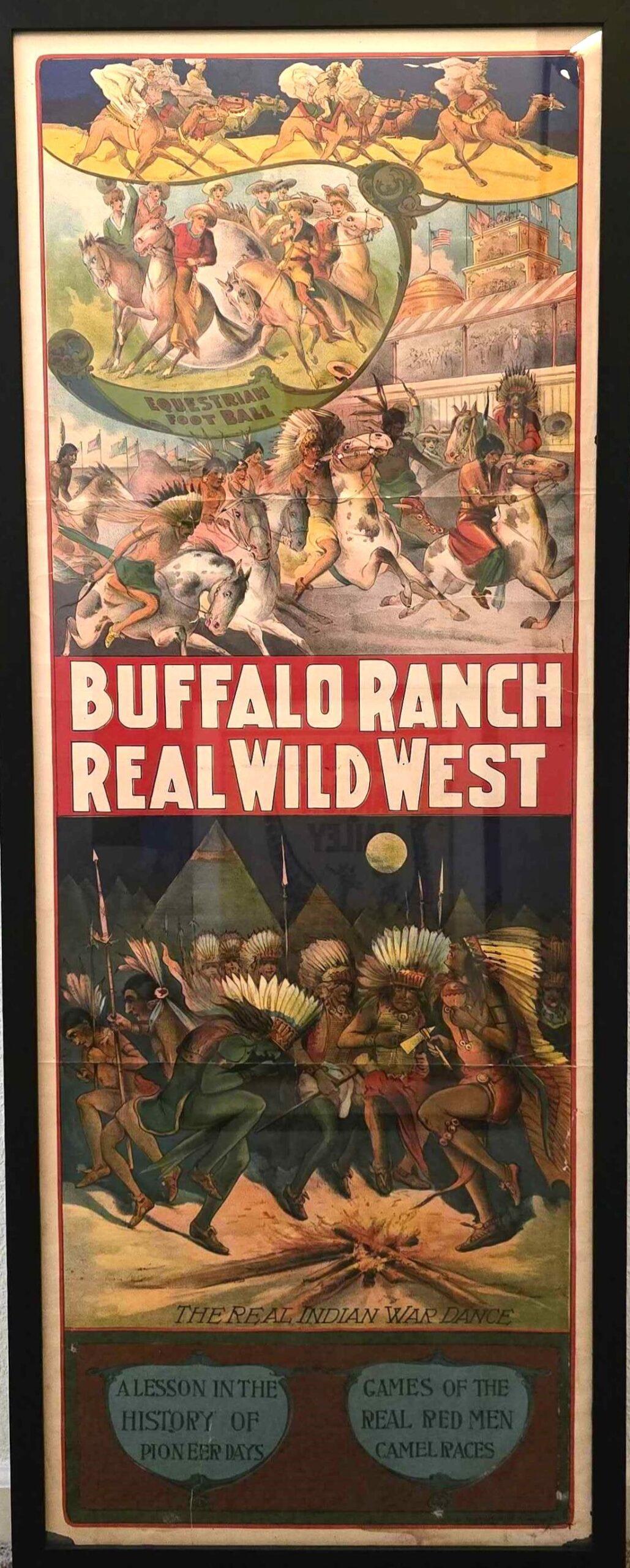
Buffalo Ranch Real Wild West Show
Stone Lithograph printed by Riverside Print Co. in Milwaukee, Wisconsin
History
The Buffalo Ranch Real Wild West Show was a traveling outdoor extravaganza launched around 1910, part of the wave of itinerant rodeos and Wild West spectacles that proliferated in the early 20th century, inspired by the groundbreaking success of Buffalo Bill Cody’s Wild West Show (1883–1913) and the Miller Brothers’ 101 Ranch Real Wild West (1905–1930s). Emerging during a period of romanticized frontier nostalgia amid rapid urbanization and the closing of the actual American West, the show toured Midwestern and Eastern U.S. towns, performing at fairgrounds, racetracks, and open lots from spring through fall. It featured a diverse cast of approximately 100 performers, including cowboys and cowgirls demonstrating roping and riding, Native American troupes enacting “war dances” and historical reenactments (often stereotypical portrayals), Mexican vaqueros in trick-riding displays, and equestrian novelties like “Equestrian Foot Ball” (mounted polo variants). Livestock included bucking broncos, wild steers for wrestling, and buffalo herds for authenticity, with parades through town streets hyping arrivals. The production emphasized “real” elements—sourcing talent from working ranches and reservations—to differentiate from vaudeville knockoffs, though it faced typical challenges like weather disruptions, animal welfare issues, and economic slumps post-World War I. By the mid-1920s, competition from film Westerns and radio eroded attendance; the show likely folded around 1920–1930, with assets dispersed to smaller circuits, leaving a legacy as a modest but vivid echo of the golden age of Wild West entertainment.
Design
Posters for the Buffalo Ranch Real Wild West Show exemplified the exuberant chromolithography of the 1910s printing boom, designed for maximum visual impact on barns, fences, and telegraph poles to draw crowds from afar. Measuring typically 20–21 x 56 inches (three-sheet size for panoramic effect) or smaller 26 x 50-inch variants, they were printed on linen-backed paper for durability during travel and pasting. Vibrant primaries dominated—ochre yellows for sun-baked plains, crimson reds for action accents, earthy browns for hides, and stark blacks for silhouettes—creating a dynamic, dust-choked tableau of Western chaos: central vignettes showed cowboys lassoing stampeding horses, cowgirls in mid-leap over barriers, feathered Native American figures in “war dance” poses, and Mexicans on rearing steeds, all framed by a horizon of tepees, buffalo, and rugged mountains evoking manifest destiny. Typography roared with bold, arched sans-serif headlines like “BUFFALO RANCH REAL WILD WEST” in oversized block letters, undercut by italicized boasts such as “The Real Indian War Dance & Equestrian Foot Ball” or “Thrilling Rodeo! Genuine Cowboys & Indians!” in script flourishes. Borrowing motifs from predecessors (e.g., Buffalo Bill’s equestrian portraits and 101 Ranch’s multicultural ensembles), designs incorporated hyperbolic borders of rifles, lassos, and tomahawks, with customizable date strips for local stops. Printed in bright, unfaded colors despite creases, tears, and marginal wear from field use, these posters blended realism (detailed tack and regalia) with caricature, capturing the era’s fusion of history and hokum.
Cultural Significance
The Buffalo Ranch Real Wild West Show and its posters embodied the Progressive Era’s obsession with frontier mythology, serving as a mobile diorama of American exceptionalism that romanticized expansionism while glossing over indigenous displacement and labor exploitation. In an age of immigration booms and industrial drudgery, these spectacles offered escapist pageantry—blending “exotic” multiculturalism (cowboys, “Indians,” Mexicans as tokenized “others”) with democratic thrills—to affirm white settler narratives for diverse audiences, from urban immigrants to rural folk, fostering a shared, if sanitized, national identity. Acts like steer wrestling and war dances reinforced gender roles (rugged men, plucky cowgirls) and racial hierarchies, influencing early Hollywood Westerns (e.g., Tom Mix serials) and civic rituals like rodeos, while subtly promoting “preparedness” themes amid pre-WWI tensions. As artifacts, the posters highlight lithography’s role in vernacular propaganda, preserving a “world-beater” aesthetic of color and excitement that masked the shows’ grueling realities. Today, they prompt critical reevaluation: celebrations of spectacle versus critiques of cultural appropriation, with renewed interest in decolonizing Western lore amid #LandBack movements and inclusive retellings like Reservation Dogs.
Production and the Company Behind It
The Buffalo Ranch Real Wild West Show operated as a proprietorship likely owned by Midwestern promoters (specific founders unrecorded, but tied to ranching circuits near Chicago or Milwaukee), with production centered on seasonal mobility: a canvas-topped arena seating 2,000–5,000, rail-car transport for 50+ horses/buffalo, and a 10–15 act program running 2–3 hours, bookended by parades with brass bands and “wild” animal processions. Performers were contracted from ranches (e.g., Texas outfits) and reservations (Lakota or Pawnee groups for “authentic” dances), with minimal training emphasizing danger for thrill—ropes, chaps, and headdresses handmade or salvaged. Budgets hovered at $10,000–$20,000 per season, offset by $0.50–$1 admissions and concessions. Posters, the show’s hype engine, were produced in runs of 500–1,000 by Riverside Print Co. (Milwaukee and Chicago branches), a prolific firm specializing in carnival lithography since the 1890s; using multi-stone chromolithography for vivid hues, they were distributed weeks ahead by advance agents for wheat-paste postings. Variants like the “Real Indian War Dance” edition targeted family crowds, with textual echoes of 101 Ranch’s multiculturalism. Post-tour, equipment wintered in Illinois barns, but the show’s brevity limited archival depth.
Relevant Archival Sources and Modern Interest in Such Labels
Archival Sources:
- Library of Congress Prints & Photographs Division (Washington, DC): Holds Wild West ephemera in the Circus and Wild West Poster Collection (ca. 1880–1930), including Riverside lithographs akin to Buffalo Ranch designs; searchable for multicultural vignettes and route proxies via American Memory portal.
- Autry Museum of the American West (Los Angeles, CA): Features Wild West show materials in the Gene Autry Western Heritage Collection, with posters and programs from 1910s itinerants; includes Native American performer oral histories contextualizing “war dance” acts.
- Buffalo Bill Center of the West (Cody, WY): Archives 101 Ranch and successor show posters in the McCracken Research Library, with cross-references to Buffalo Ranch borrowings; digitized scans available for design analysis.
- Wisconsin Historical Society (Madison, WI): Riverside Print Co. records in the Ephemera Collection, encompassing Milwaukee-era lithos and production logs for 1910s rodeos.
These posters were discovered by my parents, Arvel and Grace Allread in 1947, when the delivery of four (4) circus wagons purchased from George Christy, the owner or Christy Bros. Circus in Galveston, Texas who was liquidating his rolling stock. My father telegraphed him purchasing the wagons, which were subsequently delivered by rail to Red Bluff, California. When the wagons arrived for use with their circus, Robinson Brothers, the posters were discovered on the floor of the Ticket Wagon.
“An attractive, colorful, and action-filled poster for one of the many “Wild West” shows that were formed in the wake of Buffalo Bill Cody’s success. The Buffalo Ranch Real Wild West Show was formed around 1910 and produced shows filled with spectacle, as evidenced by this poster. The bottom half of the poster is dominated by a Catlinesque image of “The Real Indian War Dance,” as braves in headdresses and breastplates dance around a camp fire. A full moon illuminates the night sky, and a number of teepees are visible in the background. A large illustration in the upper half shows a number of Indians on horseback playing “equestrian foot ball,” while others show fancily dressed Anglo women on horseback, as well as a camel race with riders dressed in quasi-Bedouin garb. An attractive poster for a little-remembered Wild West show and a fine example of the “West (and Near East) of the Imagination.” source: William Reese Co.
These one-sheet panels (21” x 56”) or upright streamers are for the Buffalo Ranch Wild West Show, c.1913. These stone lithographs were produced by The Riverside Print Company of Milwaukee and Chicago.
Jones Bros. Buffalo Ranch Wild West Show and its successor Kit Carson Buffalo Ranch Wild West Show, was formed from the old Cole Bros. World Toured Shows (1906–09), owned by Martin Downs.
Shortly after the 1909 season Martin Downs was kicked by a horse and later died, and his show was put on the auction block in early 1910 by Fiss, Doer, and Carroll, New York horse dealers. The Billboard reported that 47 circus men attended the sale, all major shows being represented with the exception of Gollmar Bros. Largest buyer was J. A. Jones, who got a ticket wagon, calliope, bandwagons, chariots, cages, three tableaux, railroad cars, and baggage stock. Other buyers were 101 Ranch, Ringling, Josie DeMott, Bartell Animal Co., Danny Robinson, Frank A. Robbins, Fred Buchanan, Andrew Downie, and Al F. Wheeler etc. W. E. Franklin and Walter L. Main were there but didn’t buy anything.
In 1910 J. A. Jones operated the “Jones Bros. Buffalo Ranch Wild West Show”, a 14 car railroad show that traveled on 1 advance, 3 stock, 6 flats, and 4 coaches. After just one season Jones proceeded to sell his show. The December 10, 1910 Billboard reported that Thomas Wiedemann had purchased from Jones at Pulaski, Tennessee on November 12, some 29 horses, cars, wagons etc. and these were shipped to Wiedemann’s quarters at Harrisburg, Illinois. The January 7, 1911 Billboard further reported that Jones had now sold all of his show except two sleepers, the equipment having been purchased by Downie & Wheeler, Masterson Shows, and Thomas Wiedemann.
In 1911 Wiedemann used this equipment to start a Wild West Show called “Kit Carson Buffalo Ranch Wild West Show”. This was actually a combination circus and wild west show, and the performance was presented in a tent rather than the usual canvas canopy and open air arena type performance used by most wild west shows. The Kit Carson show had many circus-type acts. For 1911 one train inventory shows a total of 12 cars, 1 advance, 3 stocks, 5 flats, and 3 coaches. Another shows 14 cars, 1 advance, 3 stocks, 6 flats, and 4 coaches. (Both may be right, as it’s possible the show enlarged en tour.)
In 1912 the Kit Carson show was on 17 cars, 1 advance car, 5 stocks, 5 coaches, and 6 flats. After the 1913 season the show didn’t go back to Harrisburg, Ill. quarters but wintered in Birmingham, Alabama, and opened the 1914 season in the South.
The Kit Carson show had the reputation of being a rough and tumble grift outfit, with plenty of “hey rubes” fights when the grifters were working. Some sources say that the strong grift was what finally closed the show. On Friday, October 23, 1914 at Harlan, Kentucky, the show was shot out of town by irate locals, and the next day, Oct. 24 at Barboursville, Kentucky the show halted. Creditors had stepped into the picture, closed the show, and had it shipped to the U. S. Printing & Litho. Co. plant at Cincinnati, Ohio where it was advertised for auction. The stock was sold in December 1911, and March 20, 1915 was the time set for the sale of other properties at Cincinnati, except 5 cars and 12 wagons that were still stored at Harrisburg, but these were to be sold by description at the auction.
The Kit Carson property at the sale went for very low prices. The Billboard states that the Dodson Carnival got the calliope (which may have been the instrument only) pole wagon, stage coach, 4 baggage wagons, blacksmith wagon, two tableaux, 1 stringer wagon, and a bandwagon. J. A. Jones, Harry Hill (Wild West), and Rice & Dore got other equipment. The report also goes on to say that “outsiders” got among other things, the ticket wagon, and one tableaux wagon.
Reviews
There are no reviews yet.