
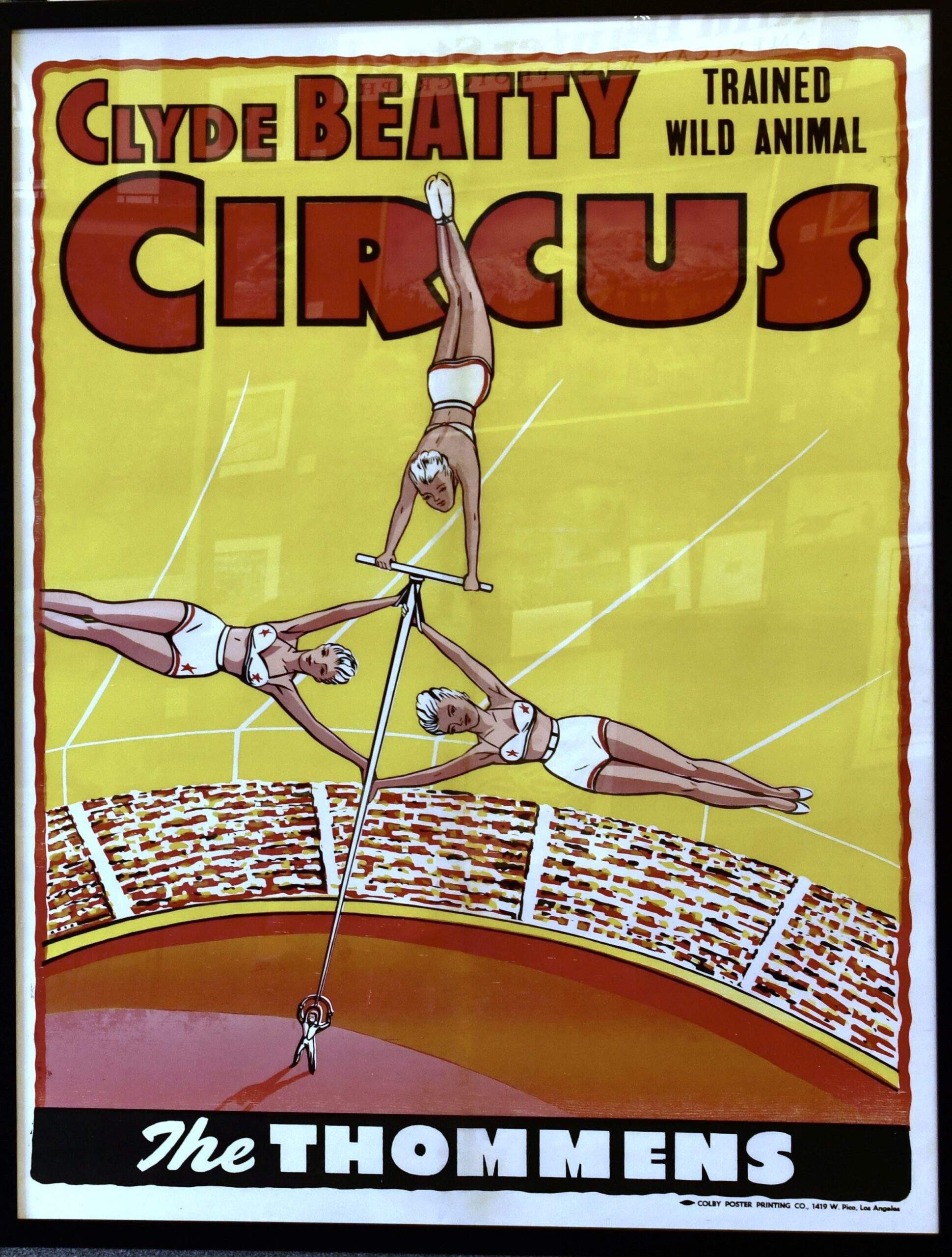
The Thommens – Clyde Beatty Circus
History
The “The Thommens – Clyde Beatty Circus” refers to a promotional poster featuring the Thommens Family, a renowned Belgian troupe of hand-balancers and acrobats, as a highlight act in the Clyde Beatty Circus during the 1950s. The Thommens, led by patriarch Jean Thommens (born 1910s, Belgium), were a multi-generational family of performers specializing in gravity-defying handstands on chairs, bottles, and canes, often atop elephants or in pyramid formations. Originating from European circuses in the 1920s–1930s (e.g., Cirque Jules-Verne in Paris), the family toured internationally, debuting in the U.S. with Ringling Bros. in the late 1940s before joining Clyde Beatty’s operation around 1952–1955. Their act blended classical European precision with American spectacle, performing 8–10 minute routines under spotlights amid big cat roars to contrast human fragility against animal ferocity.
The Clyde Beatty Circus, founded by famed lion tamer Clyde Beatty in 1945 after years with Hagenbeck-Wallace and Cole Bros., was a single-ring tent show emphasizing Beatty’s “fighting act” with mixed lions and tigers (up to 40 at peak). Headquartered in winter quarters near Fort Lauderdale, FL, it toured 100–150 dates annually across the U.S. and Canada, seating 2,000–3,000 under a 90-foot big top, with acts including elephants, aerialists, clowns, and sideshows. The Thommens’ inclusion marked Beatty’s push for diverse international talent amid postwar recovery, boosting family appeal. By 1957, the show merged with Cole Bros. to form Clyde Beatty-Cole Bros. Circus, continuing until Beatty’s death in 1965; the Thommens toured sporadically thereafter, retiring in the 1970s. The poster, likely from a 1953–1955 route (e.g., stops in Ohio, Florida), captured this era’s fusion of daring animal acts and human artistry, amid rising TV competition and animal welfare debates.
Design
The Thommens poster for Clyde Beatty Circus epitomized 1950s offset lithography’s dynamic, star-centric style, crafted for bold barn and fence postings to hype the troupe’s feats amid the show’s wild animal core. Printed as a one-sheet (28×42 inches) or half-sheet (21×28 inches) on durable, weatherproof stock, it burst with a high-contrast palette—fiery reds and oranges for dramatic tension, cool blues for spotlight glow, and stark whites for aerial clarity—evoking ring tension against a faint big top interior. Central imagery showcased the Thommens in mid-pose: a female acrobat (likely daughter or wife) balanced impossibly on one hand atop a stacked chair pyramid held by Jean or a male kin, muscles taut and leotards sequined, with subtle elephant silhouette or tiger cage in the shadows for contextual menace; family members flanked in supporting vaults, rendered in semi-realistic lines blending anatomical precision with exaggerated height for vertigo.
Typography roared with arched sans-serif block letters in 3–4-inch caps: “THE THOMMENS – EUROPE’S GREATEST HAND BALANCERS! WITH CLYDE BEATTY CIRCUS,” undercut by italic script boasts like “Death-Defying Feats on Chair, Cane & Bottle!” and a lower customizable strip for dates (e.g., “Miami, FL – Feb. 15”). Influenced by European circus posters (e.g., Chiquet lithos) and U.S. printers like Acme Show Print, the design layered motion blurs on limbs for energy, with fold creases and marginal tears from advance use adding grit. This aesthetic bridged 1940s restraint with 1950s flair, using human poise to humanize Beatty’s beastly domain.
Cultural Significance
The Thommens poster symbolized the mid-20th-century circus as a cultural crossroads—where Belgian finesse met American bravado, offering postwar audiences a metaphor for precarious balance amid Cold War anxieties and suburban flux. In the 1950s, as families sought escapist thrills from atomic shadows and economic booms, the Thommens’ hand-balancing evoked resilience: fragile humans defying gravity like nations teetering on progress, contrasting Beatty’s raw dominance over cats to underscore mastery over chaos. As immigrant stars in a heartland ritual, they democratized “exotic” artistry for blue-collar crowds at fairs and lots, fostering communal gasps that knit diverse towns in wonder, while subtly challenging gender norms (women in perilous leads). Influencing media like The Ed Sullivan Show appearances and films (Trapeze, 1956), the imagery perpetuated circus as vernacular heroism, yet foreshadowed ethical shifts—acrobats as “safer” alternatives to animal acts amid 1960s welfare stirrings. Today, post-2017 Ringling closure, it evokes nostalgic vertigo for live peril, inspiring ethical revivals (e.g., Cirque du Soleil’s aerials) and discourses on performer labor in spectacle’s golden twilight.
Production and the Company Behind It
The poster was produced by the Clyde Beatty Circus Company, a proprietorship owned by Clyde Beatty (with wife Harriett Evans as co-manager post-1933), operating from Jungle Zoo quarters in Lima, OH (1945–1956), with seasonal tours via 20–30 truck-trailer convoys for 80–100 stands. The 1950s program featured a 2-hour single-ring spectacle: Beatty’s 20-minute cat act (chair-whip-pistol confrontations), Thommens’ 10-minute balancing (trained on family compounds with safety nets minimal), elephants/chimps, clowns, and a 12-piece band; 100–150 crew multitasked rigging and concessions on $30,000–$50,000 budgets, offset by 75¢–$2 tickets. Posters printed in 500–1,000 runs by Midwestern firms like Enquirer Job Print Co. (Cincinnati) or Acme (Kansas City) used three- to four-color offsets for affordability; advance agents pasted them 2–3 weeks ahead, customizing with routes via date nails. The Thommens, contracted at $1,000–$2,000 weekly, integrated via Beatty’s European scouts, with acts rehearsed in winter quarters; post-1957 merger, production scaled under Acme Circus Operating Corp. (Jerry Collins et al.), emphasizing hybrid human-animal draws.
Relevant Archival Sources and Modern Interest in Such Labels
Archival Sources:
- New York Public Library Archives & Manuscripts (Billy Rose Theatre Division): Clyde Beatty and Cole Bros. Circus records (T-Mss-2014-001) include 1950s press releases, programs, and clippings referencing Thommens-like acrobats; searchable for international acts in merger files.
- National Fairground & Circus Archive (University of Sheffield, UK): Circus Friends Association Collection holds ephemera (posters, photos, films) on 1950s U.S. tours, including Thommens’ European-U.S. transitions and Beatty integrations; digitized programs detail hand-balancing routines.
- Illinois State University Milner Library Special Collections: Clyde Beatty Collection (donated 2015) features route books (1953–1961), posters, and personnel lists noting Thommens; complements Circus & Allied Arts holdings with acrobat ephemera.
- The Huntington Library (San Marino, CA): Jay T. Last Collection includes 1950s circus lithos and broadsides; searchable for Beatty posters with acrobat vignettes.
Reviews
There are no reviews yet.