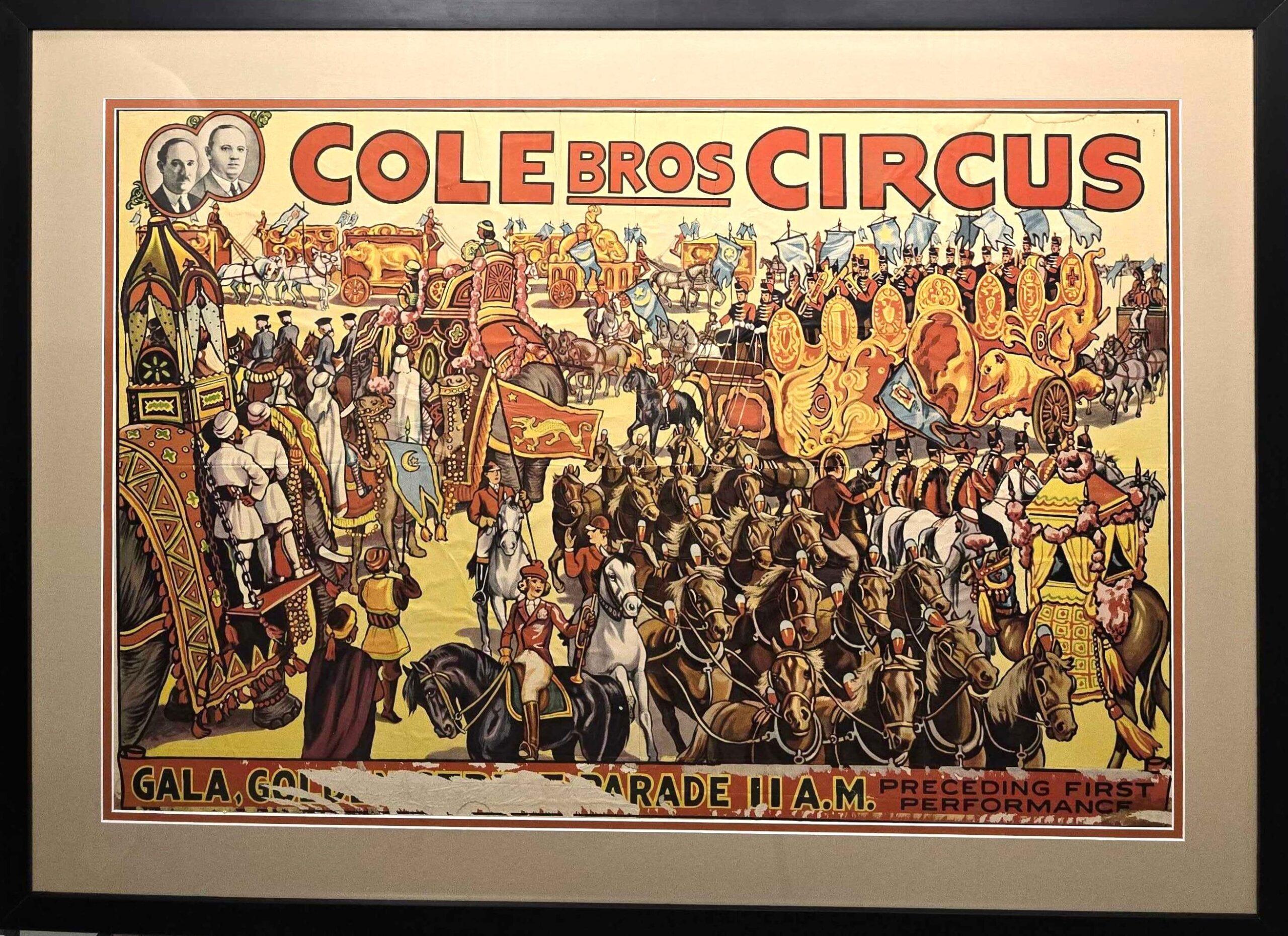
Cole Bros Circus Gala, Golden Street Parade 11 A.M. One Sheet Poster c. 1930
Printed by the Erie Litho Company
History and Background of the Cole Bros. Circus and the Gala, Golden Street Parade 11 A.M. One Sheet Poster
Origins of the Cole Bros. Circus
The Cole Bros. Circus, a prominent medium-sized American circus, was founded in 1884 by William Washington Cole (1847–1915) as “W.W. Cole’s New Colossal Shows.” Based in Louisville, Kentucky, the circus aimed to deliver grand spectacles, combining trained animal acts, acrobatics, and clowning to captivate audiences across the United States. In 1900, ownership passed to Canadian showmen Martin and James Down, at which point the name changed to Cole Bros. Circus, reflecting a shift in management and branding while maintaining its commitment to large-scale entertainment. The circus became known for its vibrant performances and elaborate street parades, which were a hallmark of its public appeal in the early 20th century.
Key Milestones and Evolution
Early Growth (1884–1930s)
-
1884: W.W. Cole established the circus, capitalizing on the growing popularity of traveling shows in the United States. The circus used horse-drawn wagons initially but transitioned to rail travel by the early 20th century, reflecting the era’s technological advancements.
-
1900: The acquisition by Martin and James Down marked a new era, with the circus expanding its reach and reputation through strategic marketing and high-profile acts.
-
1930s: The circus employed renowned animal trainers Clyde Beatty and Allen King, both of whom traveled in their own railroad cars, underscoring their star status. In 1935, Beatty’s first season with the circus marked a significant boost in its popularity, with his lion and tiger acts drawing large crowds. The circus traveled on 35 double-length railroad cars, a logistical feat that enabled it to visit numerous towns and cities.
Rebirth and Peak (1934–1957)
-
1934–1935: The Cole Bros. Circus was revitalized in Rochester, Indiana, under the management of Jess Adkins and Zach Terrell. The circus opened its 1935 season at the Chicago Coliseum on April 20, featuring Beatty and King’s thrilling animal acts, high school horses, trained seals, and a Liberty horse act. This period saw the circus rebranded as a “new big-time circus,” with Rochester as its home base, proudly carrying the city’s name across the country.
-
1930s Parades: The circus was famous for its grand street parades, which moved from railroad yards to performance grounds, showcasing elephants, baggage horses, and vibrant wagons. These parades, often held at 11 a.m., were a key promotional tool, drawing crowds to the main show.
-
1940 Fire: A tragic fire in Fulton County, Indiana, killed many of the circus’s animals, marking a significant setback. Despite this, the circus continued to tour, though it faced ongoing challenges with animal welfare compliance.
Clyde Beatty Era and Decline (1957–2016)
-
1957: The circus was renamed the Clyde Beatty-Cole Bros. Circus after being acquired by the Acme Circus Operating Corporation, formed by Jerry Collins, Frank McClosky, Randolph Calhoun, and Walter Kernan. This era saw the circus become the largest tent show on the road, with a focus on Beatty’s wild animal acts.
-
1981–1982: In an unprecedented move, Jerry Collins donated the circus to Florida State University to benefit the community and academia. A year later, it was sold to John Wallace Pugh, a long-serving manager who revitalized the show as the “World’s Largest Circus Under the Big Top.” Pugh’s leadership emphasized traditional circus elements, including the big top tent, until the circus’s final years.
-
Animal Welfare Controversies: The circus faced repeated citations from the USDA for failing to meet Animal Welfare Act standards, including inadequate veterinary care and animal handling practices. Notable incidents included a 1999 case involving the abusive use of a bullhook on elephants and a 2004 tiger escape in Forest Park, New York. These issues, combined with pressure from animal rights activists, led to the phasing out of elephant acts and the circus’s eventual closure.
-
2016 Closure: By 2014, the Cole Bros. Circus was one of the few remaining traditional tent circuses in the U.S. However, declining attendance, high operating costs, and animal welfare controversies led to its closure in 2016, marking the end of its 132-year run.
The Gala, Golden Street Parade 11 A.M. One Sheet Poster
Origins and Composition
The “Gala, Golden Street Parade 11 A.M.” one sheet poster, dating to the 1930s, was a vibrant promotional tool for the Cole Bros. Circus, designed to draw crowds to its spectacular street parades. These parades, typically held at 11 a.m. before the first performance, were a key feature of the circus’s marketing strategy, showcasing its grandeur and enticing audiences to attend the main show. The poster, measuring approximately 44 x 31.5 inches, was likely printed by a company such as Erie Litho. & Ptg. Co., known for producing colorful circus posters. Its design featured bright reds and yellows, bold text, and imagery of exotic animals and performers, emphasizing the circus’s claim as the “Biggest and Best Circus in the World.”
The poster’s content highlighted the parade’s procession, which included:
-
Bugle Brigade: Announcing the parade’s start with fanfare.
-
Horses and Flag Bearers: Adding pageantry and patriotic flair.
-
Band Wagons: Featuring live music from uniformed concert bands.
-
Animal Cages: Displaying elephants, lions, and other exotic animals, some in open cages to attract curiosity.
-
Performers: Clowns, acrobats, and equestrians in colorful costumes, showcasing the circus’s diverse acts.
-
Steam Calliope: The traditional finale, known as the “Pied Piper” of the circus, with its distinctive music drawing crowds.
The poster’s bold claims, such as “Fun for the Whole Family” and “Stupendously Presenting the World’s Famous, Biggest and Greatest Features,” reflected the circus’s promotional style, designed to evoke excitement and grandeur.
Significance
The Gala, Golden Street Parade poster was a critical component of the circus’s advertising strategy, embodying the spectacle and allure of the Cole Bros. Circus. These posters were often linen-backed for durability and distributed widely to announce the circus’s arrival in town. Their vivid imagery and exaggerated claims captured the public’s imagination, making the parade a must-see event. The parade itself was a logistical marvel, requiring coordination between performers, animal handlers, and crew to move from rail yards to circus grounds, reinforcing the circus’s reputation as a mobile spectacle. The poster’s emphasis on the 11 a.m. parade underscored its role as a free public event that boosted ticket sales for the main performances.
Acts and Performers
The Cole Bros. Circus featured a diverse array of acts, blending traditional circus elements with innovative performances:
-
Clyde Beatty and Allen King: In the 1930s, Beatty and King were the circus’s star animal trainers, performing thrilling lion and tiger acts. Beatty, who joined in 1935, was a national celebrity whose performances drew massive crowds. King, featured in the 1934 Chicago World’s Fair, complemented Beatty with his own wild animal displays.
-
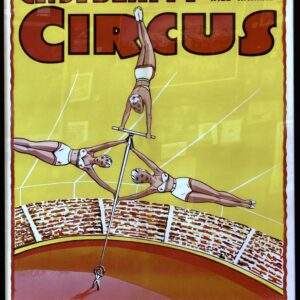
The Nelson Family: This acrobatic troupe was highlighted in a colorful poster by Erie Litho. & Ptg. Co., showcasing their dynamic performances, likely involving tumbling and balancing acts.
-
The Cristiani Family: In 1946, this renowned family performed briefly with the circus, featured in a rare sepia-toned poster. Their act, likely involving equestrian or acrobatic feats, was so prominent that posters were altered after their departure to remove their name.
-
Bob Strehlau (Juggles the Clown): A well-known clown, Strehlau added humor and charm to the circus’s lineup, engaging audiences with his comedic routines.
-
Alpine Troupe: In 1909, this English wire-walking family, led by Charles Alpine and including his wife, two daughters (Beatrice and her sister), and son, performed a double wire act, showcasing precision and coordination.
-
Equestrian and Animal Acts: The circus featured high school horses, trained seals, dog and pony drills, and Liberty horse acts, emphasizing its strong equestrian tradition. These acts were central to its appeal, especially during the 1930s revival.
The performance style combined high-risk feats, such as Beatty’s animal taming and the Alpine Troupe’s wire walking, with theatrical elements like clowning and music. The circus’s big top, supported by dozens of feet-tall side poles, created an immersive environment where multiple acts performed simultaneously, enhancing the spectacle.
Mode of Travel
The Cole Bros. Circus was a railroad circus, traveling on 35 double-length railcars in the 1930s, which carried performers, animals, and equipment. The railcars included flatcars for baggage wagons and stock cars for elephants and horses, with notable cars marked for Clyde Beatty and Allen King. The circus’s daily routine involved unloading at rail yards, parading through town, and setting up the big top, a process repeated morning and night as the circus moved to new locations. By 1939, the Cole Bros. Circus held its last horse-drawn parade, transitioning to motorized transport in the 1940s, though it retained its big top tent, distinguishing it from competitors like Ringling Bros., which moved to indoor arenas in 1956. The use of railroads allowed the circus to cover vast distances, performing in cities and small towns across the U.S., with winter quarters in Rochester, Indiana, during the 1930s revival.
Impact on the Circus’s Legacy
The Cole Bros. Circus left a lasting legacy as one of America’s longest-running tent circuses, known for its vibrant street parades and star performers. The Gala, Golden Street Parade poster encapsulated the circus’s ability to captivate audiences through spectacle and promotion, contributing to its reputation as a cultural institution. Performers like Clyde Beatty and the Cristiani Family became synonymous with circus excellence, while the parade’s grandeur reinforced the circus’s role as a community event. Despite its closure in 2016 due to animal welfare controversies and economic challenges, the circus’s artifacts, including posters, are preserved in collections like the Library of Congress and the Circus World Museum, reflecting its historical significance. The Cole Bros. Circus, through its parades and performances, helped define the American circus tradition, influencing modern circuses and leaving a nostalgic imprint on popular culture.
Sources
-
Wikipedia: Cole Bros. Circus
-
Library of Congress: Cole Bros. Circus
-
Encyclopaedia Britannica: Circus
-
Sheffield Archives: Clyde Beatty Cole Bros. Circus
-
Golden Age Posters: Cole Bros. Circus Gala Poster
-
Born Free USA: Cole Bros. Circus Incident Reports
-
Fulton County Indiana: Cole Bros. Clyde Beatty Circus
-
Library of Congress: Cole Bros. Circus Nelson Family
-
Cool Cultural Heritage: Ethical Considerations for Circus Posters
-
Circopedia: Short History of the Circus
Reviews
There are no reviews yet.