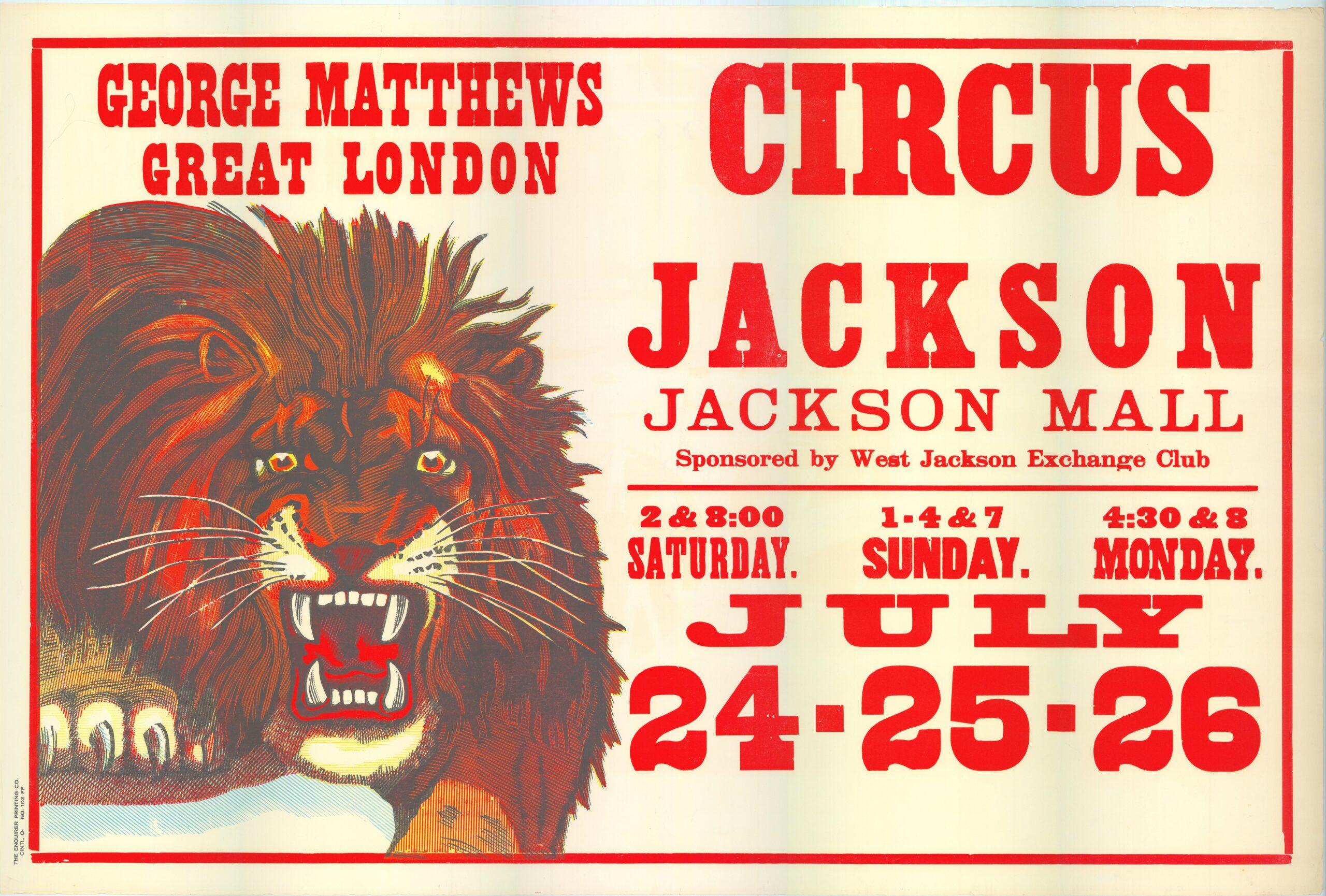
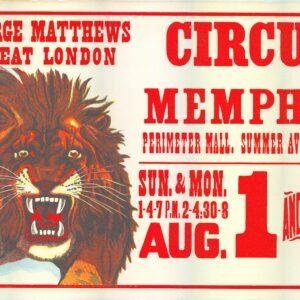
George Matthews Great London Circus Poster, Circa 1972
History
The George Matthews Great London Circus was a small, family-operated tent circus that toured primarily in the United States and parts of Canada during the 1970s. It originated from the entrepreneurial efforts of Sid Kellner, a former concessionaire who entered the circus business in the 1950s by selling popcorn at shows. In 1966, Kellner purchased the assets of the defunct Mills Bros. Circus, launching his own operation under the name James Bros. Circus. This show featured a modest big top, a menagerie of animals (including elephants, chimpanzees, and big cats), clown acts, acrobats, and a live band. By the late 1960s or early 1970s, following a severe “blow down” incident where the main tent collapsed during a storm, Kellner rebranded the circus as the George Matthews Great London Circus, honoring his two sons, George and Matthew. (Kellner’s marriage to Lovie Kellner had ended in divorce, with Matthew living with his mother.)
The circus operated on a seasonal basis, touring routes that included stops in Kansas City, MO; Cincinnati, OH; Columbia, MO; Santa Monica, CA; Calgary, AB; and Cuyahoga Falls, OH, often playing at local fairs, fire company events, and community lots. Winter quarters were maintained near Houston, TX (on an elephant farm) and in Martinez, CA (shared with a carnival operation). The show employed a mix of family members, hired performers, and seasonal roustabouts, with acts like hand-balancing duos (e.g., Roland and Marcia), chimp routines, and a sideshow featuring an “electric man.” A baby elephant named Elly was a highlight, cared for by crew members. The band, led by accordionist Cliff Moresi, augmented with union musicians for larger dates, played brass-heavy tunes on instruments like trumpets, trombones, and tubas.
Financially modest, the circus relied on advance promotions, free tickets for local dignitaries, and crew multitasking (e.g., sewing costumes, welding equipment). It faced typical challenges of small shows, including payroll disputes at season’s end and nomadic hardships like living in semi-trailers. Operations wound down by the late 1970s, with equipment sold off in 1978 to fund other ventures; Kellner, who lived to 91, reflected on it as a labor of love tied to his family’s legacy.
Design
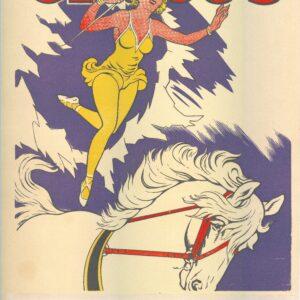
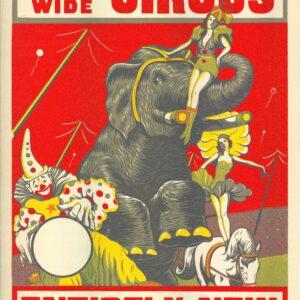
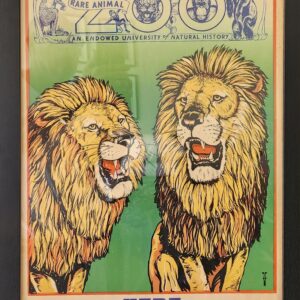
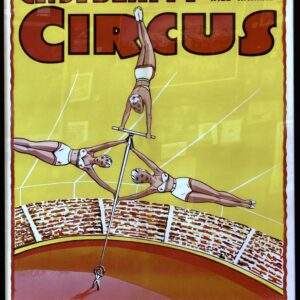
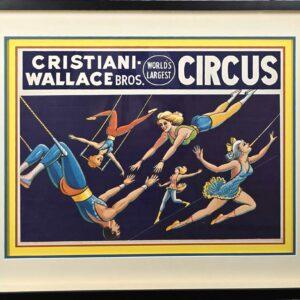
The circus’s visual identity, particularly its posters, embodied the exuberant, larger-than-life aesthetic of mid-20th-century American circus advertising. Posters were bold, lithographic-style prints in vibrant primaries—reds, yellows, blues—to grab attention from afar, a holdover from the golden age of circus lithography pioneered by firms like Strobridge & Co. Designs typically centered on the big top tent as a focal point, flanked by dramatic illustrations of exotic animals leaping or roaring (e.g., tigers mid-pounce, elephants rearing, zebras and rhinos in dynamic poses) to evoke adventure and spectacle. Clowns with exaggerated features, acrobats in mid-air, and sideshow banners added layers of whimsy and intrigue.
Specific examples include:
- No. 63 Poster (1972): A 14×42-inch one-sheet depicting a snarling tiger, trumpeting elephant, striped zebra, and charging rhino against a striped tent backdrop, with text announcing “Thrilling Wild Animal Acts” and tour dates.
- Great African Lion Half-Sheet: A smaller 11×28-inch flat focusing on a lion-tamer confrontation, offering “FREE TICKETS HERE” to lure passersby.
These designs prioritized hyperbole and fantasy, using sans-serif fonts for headlines like “GEORGE MATTHEWS GREAT LONDON CIRCUS” in block letters, often with location-specific date strips added post-printing. The overall style reflected 1970s offset printing techniques, blending realism with cartoonish exaggeration to appeal to families and rural audiences.
Cultural Significance
The George Matthews Great London Circus captured the twilight of America’s traditional tent circuses, a cultural institution rooted in 19th-century European imports but deeply embedded in U.S. folklore as symbols of escapism, community gathering, and the American Dream’s itinerant spirit. In the 1970s, amid economic pressures and emerging animal welfare activism (e.g., early campaigns against elephant training), small shows like this one represented resilience—family dynasties preserving “sawdust” traditions against the rise of corporate spectacles like Ringling Bros. It embodied the “hey rube” camaraderie of circus folk, where performers, crew, and locals mingled, fostering oral histories of hardship and hilarity that influenced later depictions in media (e.g., films like The Greatest Showman or documentaries on vanishing big tops).
Posters and ephemera from the show serve as artifacts of vernacular graphic design, illustrating how advertising shaped public imagination of the “exotic” and “wild” in post-Vietnam America. They highlight themes of spectacle as social glue in small towns, where circuses boosted local economies and morale at fairs and fundraisers. Today, they underscore the ethical evolution of entertainment, with retrospective interest in how such shows balanced wonder with exploitation.
Production and the Company Behind It
The circus was produced by Sid Kellner as a sole proprietorship, with input from family and long-term associates like bandleader Cliff Moresi and promoter Lou Ann Jacobs. Production emphasized low-cost, high-mobility operations: a single-ring big top seating 1,000-1,500, a 10-12 piece band, and a sideshow annex. Animals were sourced from auctions and prior shows, with care handled by crew (e.g., Elly the elephant’s daily routines). Costumes and props were handmade or repaired on-site.
Posters, the show’s primary marketing tool, were mass-produced by The Enquirer Printing Co. of Cincinnati, OH—a prolific Midwestern firm known for circus and fair lithography since the early 1900s. These were distributed weeks in advance for window displays, with crews plastering them on barns and poles to build hype. Printing runs likely numbered in the hundreds per design, customized with route cards for specific venues like the Butler County Fairgrounds or Louisville, KY.
Relevant Archival Sources and Modern Interest in Pieces of Art
Archival Sources:
- Circus World Museum (Baraboo, WI): Holds original posters in its extensive collection of over 10,000 items, documenting U.S. circus ephemera from 1841 onward; searchable via UW-Madison Libraries catalog.
- Oklahoma Historical Society: Archival photographs of performances, part of the Oklahoma Journal Collection.
- Windjammers Unlimited (Circus Fans Association): Publications like Circus Fanfare index entries on the show’s 1973 debut and routes; digital compendiums available online.
- The Circus Blog: Oral histories and photos from alumni like Ivan M. Henry, detailing daily life.
Reviews
There are no reviews yet.