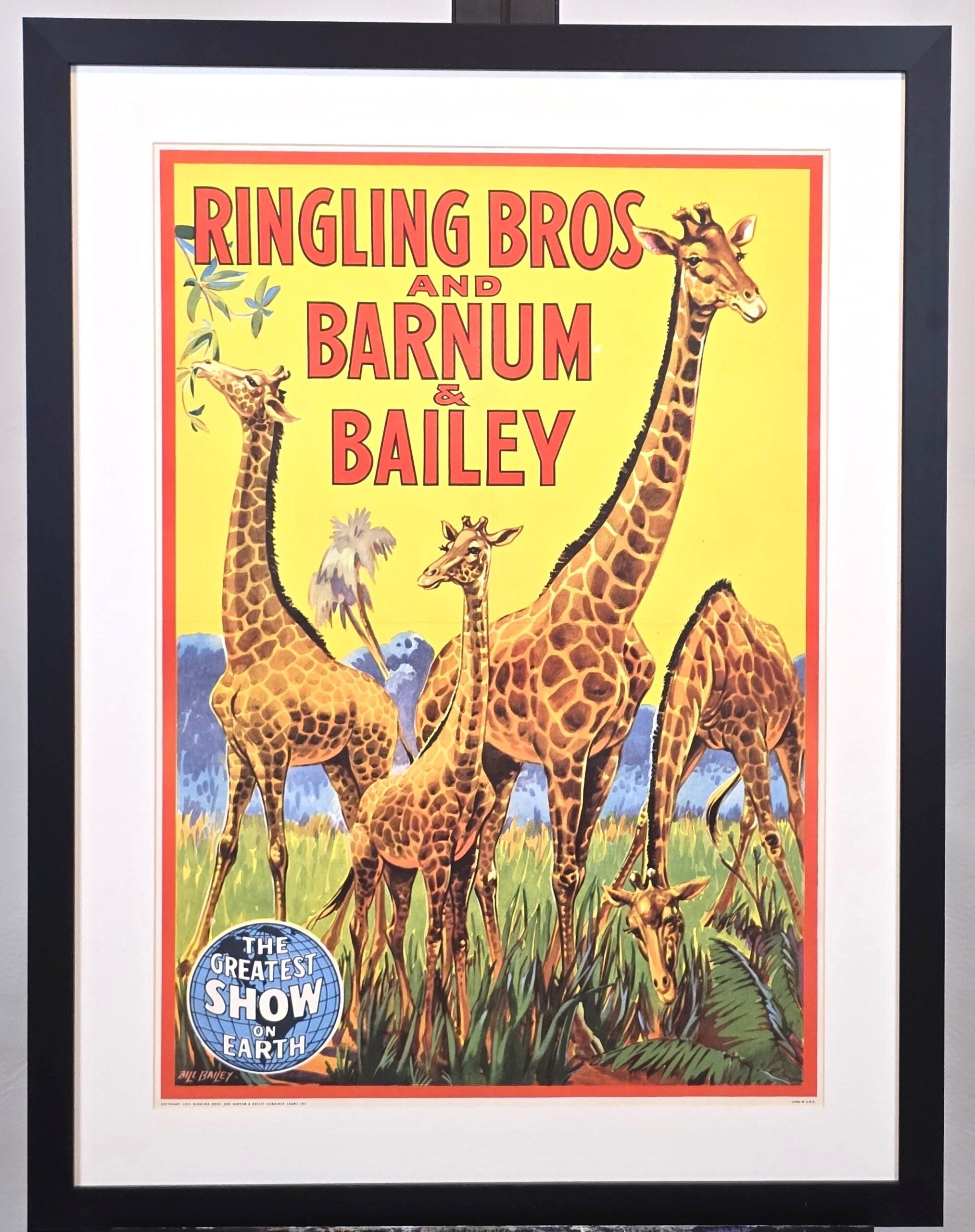
Giraffes – Ringling Bros. Barnum & Bailey – C. 1944
History
The “Giraffes – Ringling Bros. Barnum & Bailey” refers to a classic promotional poster from the Ringling Bros. and Barnum & Bailey Combined Shows, often titled “The Greatest Show on Earth,” highlighting the circus’s exotic menagerie. This specific design dates to circa 1944, during the postwar era when the circus was retooling after a wartime hiatus (1942–1943) due to travel restrictions and material shortages. The Ringling Bros. circus, founded by five Wisconsin brothers (Albert, Otto, Alfred, Charles, and John) in 1884 as a small railroad-backed wagon show, acquired the Barnum & Bailey Circus in 1907 for $410,000, merging the operations by 1919 into the iconic Combined Shows. By the 1940s, under John Ringling North’s leadership, the show boasted a vast menagerie sourced from global expeditions, including giraffes imported from Africa via brokers like Frank C. Bostock, emphasizing “rarities” like the “only full-grown specimens seen in America” in earlier iterations.
Giraffes were marquee attractions, debuting in the 1910s as symbols of untamed height and elegance, featured in parades and feeding demos to awe audiences. The 1944 poster promoted the Blue Unit tour’s 100+ stands across U.S. arenas and tents, seating 5,000–15,000, amid economic recovery that saw attendance rebound to millions annually. Challenges included animal transport (rail cars with heated stalls) and welfare scrutiny, but giraffes embodied the show’s imperial spectacle. Operations continued until 2017, when animal acts ended amid PETA campaigns, with giraffes retired to sanctuaries; the poster endures as a relic of the “Golden Age” menagerie era.
Design
The 1944 “Giraffes” poster exemplifies mid-20th-century offset lithography’s bold, illustrative exuberance, engineered for high-visibility barn and billboard postings to lure families from afar. Measuring approximately 28×42 inches (one-sheet) or 21×27.5 inches (half-sheet) on heavy, weatherproof stock, it employs a sun-drenched palette of earthy ochres and tans for giraffe hides, vivid greens for savanna backdrops, and pops of crimson and yellow for accents, evoking African wilds against a minimalist horizon. The composition centers a “tower” of four giraffes in dynamic profile—necks arched skyward in a graceful cluster, spots rendered in stippled detail for texture, eyes wide with anthropomorphic curiosity—framed by faint acacia trees and a distant big top, blending photorealism with whimsical exaggeration to convey towering majesty.
Typography commands attention with arched sans-serif block letters in 4-inch caps proclaiming “RINGLING BROS. AND BARNUM & BAILEY – THE GREATEST SHOW ON EARTH!” in bold yellow-outlined red, undercut by script flourishes like “See the Majestic Giraffes!” and a lower date strip for custom routes (e.g., “Chicago – Aug. 10”). Influenced by earlier Strobridge Litho designs (e.g., 1910s animal parades), the layout prioritizes verticality to mimic giraffe stature, with fold lines, edge tears, and paste remnants from field use adding patina. This style shifted from Depression-era restraint to postwar optimism, using animals as silent stars to symbolize unbridled wonder.
Cultural Significance
The “Giraffes” poster encapsulated the Ringling circus as America’s postwar escapist colossus—a canvas of colonial fantasy where elongated necks bridged mundane heartlands to distant savannas, romanticizing empire and exoticism for a generation healing from global scars. In 1944, amid rationing’s lift and suburban dreams, giraffes symbolized aspirational height: untouchable elegance tamed for spectacle, reinforcing manifest destiny while glossing animal capture’s brutality (e.g., 1930s African hunts). As vernacular art, it democratized “wilderness” for diverse crowds—urban immigrants, rural families—fostering communal awe at arenas where clowns and brass bands knit social fabrics, influencing pop culture from Disney’s Dumbo (1941) to The Greatest Showman (2017). Yet, it subtly critiqued captivity’s ethics, foreshadowing 1970s welfare reforms and 2017’s animal-free pivot. Today, amid #EndAnimalExploitation, the poster evokes bittersweet nostalgia for imperiled traditions, sparking dialogues on decolonizing spectacle and heritage in ethical revivals like Cirque du Soleil, where giraffe motifs nod to lost marvels without chains.
Production and the Company Behind It
Ringling Bros. and Barnum & Bailey Combined Shows, Inc., a family-held corporation wintering in Sarasota, FL (post-1927 bridge opening), produced the poster under John Ringling North’s vision as part of a $100,000+ annual publicity arsenal for the 1944 tour: a three-ring extravaganza with 1,000 performers, 300 animals (including 4–6 giraffes in ventilated rail cars), and 50 acts transported by 50-train cars for 200+ dates. Giraffes, fed acacia branches and housed in 20×20-foot enclosures, starred in 15-minute parades and feeding shows, sourced from African imports via agents like Hagenbeck-Wallace alumni. Posters printed in runs of 1,000–2,000 by regional offsets (e.g., Acme Show Print or Enquirer Job Print Co., successors to Strobridge) used four-color processes for vibrancy; advance crews pasted them weeks ahead, customizing with routes via nail-stuck panels. Budgets balanced $0.75–$2.50 tickets against $50,000 seasonal costs, with giraffes as “rarity draws” boosting 20% attendance. In-house designers adapted 1920s templates, emphasizing menagerie scale amid wartime paper rationing.
Relevant Archival Sources and Modern Interest in Such Labels
Archival Sources:
- Library of Congress Prints & Photographs Division (Washington, DC): Holds the 1944 “Giraffes” offset poster (No. 2019636163) in the Circus Poster Collection, with digitized scans and folklife recordings on menagerie logistics; searchable via American Memory for 1940s routes.
- The John and Mable Ringling Museum of Art (Sarasota, FL): eMuseum features “Wild Animals” variants (e.g., giraffes with lions/rhinos, ca. 1920s–1940s) in the Circus Collection, plus Tibbals Learning Center rotations; includes Howard Bros. models and ephemera.
- New York Public Library Billy Rose Theatre Division: Digital Collections archive 1920s–1940s Ringling posters, including giraffe-inclusive designs; contextualizes with merger histories and route books.
- University of Minnesota Visual Resources Center: UMVA Photo Archive (No. 2105) preserves early giraffe posters (ca. 1910s), with inserts of the Ringling brothers; aids design evolution studies.
Giraffes have been a notable attraction in the Ringling Bros. and Barnum & Bailey Circus, often featured in their performances and promotional materials. Here are some key points about giraffes in this famous circus. The Ringling Bros. and Barnum & Bailey Circus, known as “The Greatest Show on Earth,” has showcased giraffes as part of their animal acts and menagerie. These towering creatures have been a popular draw for audiences, highlighting the exotic and spectacular nature of the circus. When not touring, the circus animals, including giraffes, were housed at the Ringling Bros. and Barnum & Bailey Winter Headquarters in Sarasota, Florida. Photographs from this location show giraffes in their winter quarters, providing a glimpse into the off-season life of these circus animals. Circus clowns, a staple of the Ringling Bros. and Barnum & Bailey shows, sometimes interacted with giraffes as part of their acts. One notable example is Lou Jacobs, a famous Auguste Master Clown, who was photographed performing alongside a giraffe. The inclusion of giraffes in the Ringling Bros. and Barnum & Bailey Circus reflects the show’s commitment to presenting exotic and awe-inspiring attractions to their audiences, contributing to their reputation as “The Greatest Show on Earth.” Authentic vintage poster art enhances your lobby, offices and homes. Perfect for staging companies, real estate agents, brokers and home owners.
Reviews
There are no reviews yet.