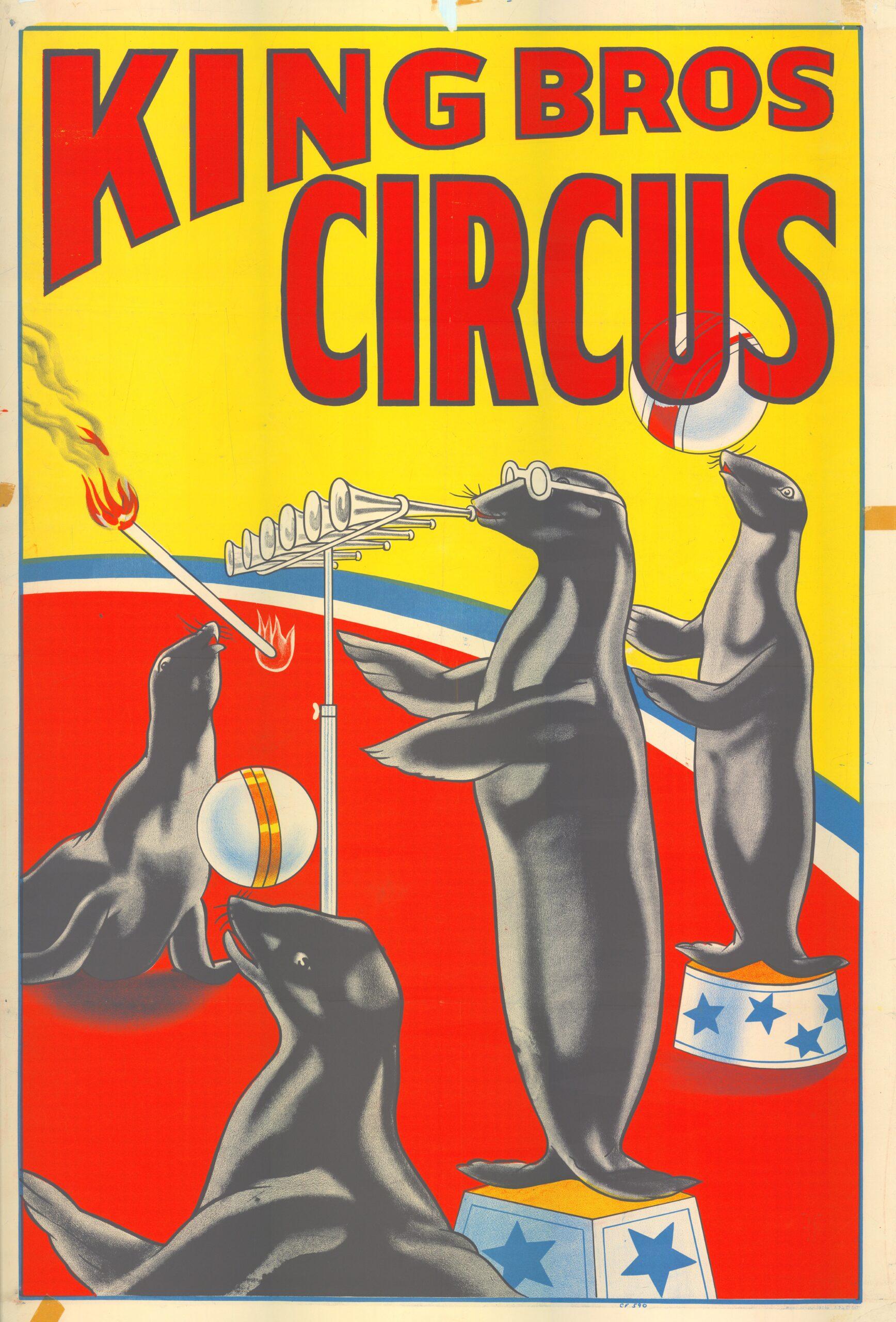
King Bros Circus Seals – Unframed One Sheet c. 1950
Printed by The Enquirer Printing Company, Cincinnati, Ohio
The King Bros. Circus Seals refer to colorful, adhesive paper seals (or stickers) used as promotional ephemera by the King Brothers Circus, a mid-20th-century American traveling show. These seals, often depicting circus animals, performers, or motifs like lions and clowns, were distributed as giveaways or pasted on programs, tickets, and souvenirs to build brand loyalty and excitement. Produced during the circus’s peak touring years, they exemplify the era’s vibrant lithographic printing for disposable marketing, blending whimsy with commercial appeal in a time when circuses were fading cultural staples.
History and Production
The seals emerged in the 1940s–1950s, aligning with the King Brothers Circus’s operations amid post-WWII economic recovery and suburban expansion, which challenged traditional tent shows. The U.S. circus industry, rooted in the 1790s with Philip Astley’s London amphitheater, boomed in the 19th century via rail tours but faced decline by the 1950s due to television, highways, and animal welfare concerns. King Bros. seals were lithographically printed—using multi-color stone-transfer techniques for vivid, affordable runs—on gummed paper sheets (typically 2–4 inches in diameter), perforated for easy detachment. Produced seasonally before tours (spring–fall), thousands were made by regional printers like those in Ohio or Florida, distributed at stops to children or affixed to merchandise. Variations included animal-themed sets (e.g., seals with performing sea lions) or promotional bursts, with minor wear from handling; the format persisted until the circus folded in 1956, as circuses shifted to permanent venues.
Design
These seals featured bold, illustrative designs capturing circus spectacle: central images of acrobats on elephants, grinning clowns, or trained seals balancing balls, rendered in saturated reds, blues, and yellows against white or starry backgrounds. Typography proclaimed “King Bros. Circus” in playful, arched script, often with starbursts or tents for dynamism. Sized for easy application (1.5–3 inches), they drew from 1940s commercial art trends—simplified Art Deco lines with cartoonish flair—to evoke joy and urgency, ensuring they popped on paper goods or lapels. Printed in sets of 6–12, the whimsical, child-friendly aesthetic mirrored broader ephemera like ticket stubs, prioritizing memorability over durability.
Company Behind It
Produced by King Brothers Circus, founded in 1946 by Floyd King in Ohio as a modest 2-truck operation after he and brother Howard managed shows like Sanger, Harris Bros., Walter L. Main, Gentry Bros., and Cole Bros. Circuses since 1919. The family-run enterprise, headquartered in winter quarters near Cincinnati, toured the Midwest and South with a big top tent, featuring 20+ acts including elephants, aerialists, and sideshows. Affiliated loosely with the International Alliance of Theatrical Stage Employees for labor, it emphasized affordable family entertainment, shipping via truck (post-rail era). Key figures Floyd (producer) and Howard (advance man) drove growth to a 40-truck show by 1950, but financial strains from weather and competition led to closure in 1956. No major mergers followed, but the Kings’ legacy influenced smaller mud shows.
Cultural Significance
King Bros. seals romanticize the American circus as escapist Americana—a fleeting “greatest show on earth” symbolizing wonder, diversity (multicultural performers from Europe to Asia), and post-war optimism, while glossing over harsh realities like animal training ethics and itinerant labor hardships. They evoke 1950s nostalgia for tent life amid cultural shifts (e.g., Disney’s rise), serving as kid-centric talismans that blurred commerce and play, much like Cracker Jack prizes. As ephemera, they highlight advertising’s role in commodifying spectacle, sparking modern reflections on conservation (e.g., phasing out animal acts) and inclusivity in exhibits on pop culture ephemera.
Archival Sources and Modern Interest
- Jay T. Last Collection of Entertainment: Circus Prints and Ephemera (Huntington Library): Digitized archive with King Bros. posters and related ephemera (ca. 1940s); searchable via Online Archive of California, including lithograph examples and production notes.
- Circus World Museum (Baraboo, WI): Holds King Bros. artifacts in its ephemera library; features seals in rotating exhibits on mid-century mud shows, with research access via appointment.
- eBay and Collectors Weekly Auctions: Active listings for King Bros. ephemera, including seals ($5–$50 for lots); forums discuss rarity amid 2025 nostalgia surges.
- Modern Interest: Sought by junk journal crafters and circus historians on Etsy/Pinterest (printable replicas for $2–$10); featured in 2023–2025 exhibits like “Ephemeral Spectacles” at the Smithsonian, with values rising 20% yearly for unused sheets amid vintage revival. Annual swaps via the Circus Historical Society highlight their role in preserving “tent town” heritage.
This vintage the King Brothers Circus unframed one-sheet poster (42 inches tall by 28 inches wide) in 4 colors (yellow, red, blue, black) is from a Chico, California show feature seals playing horns, balancing beach balls and flaming batons. NOTE: Although the artwork is unsigned on this poster, another poster with a nearly identical rendering is signed “Roland Butler”.
This circus and many others like it drove to and set up on a multi-acre empty lot called Hahn Field. The poster mis-spelled the name Hahn. I know because I went to school with Mark Hahn for many years. The site is now a Chico State College apartment complex called “The Zoo” in honor of it’s circus history.
Reviews
There are no reviews yet.