

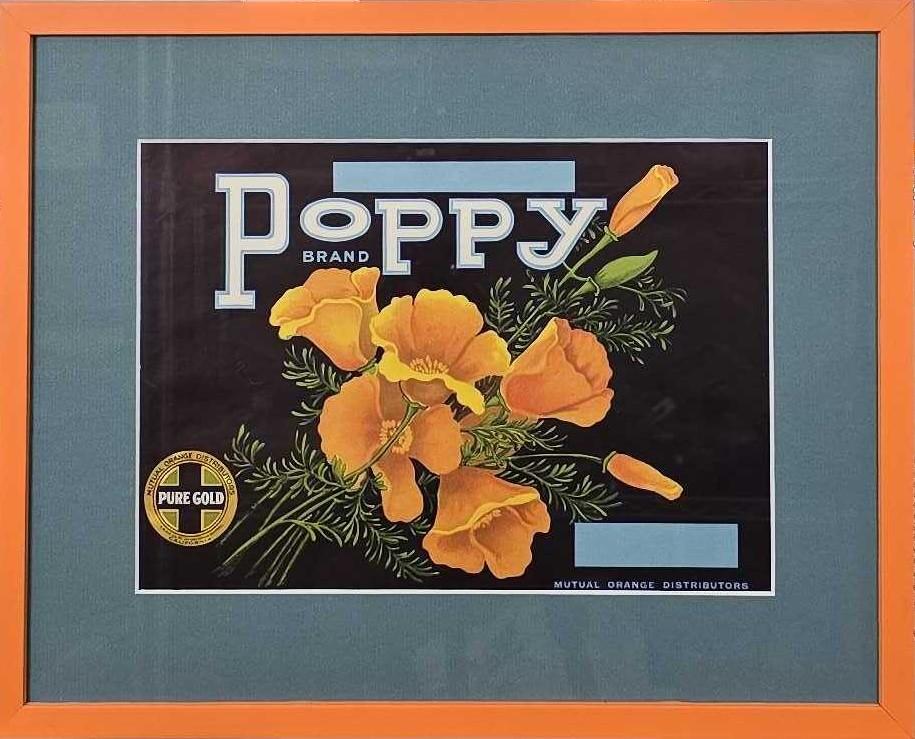
Poppy Brand Oranges Fruit Label C. 1930
This gorgeous label measures 12 1/2 inches wide by 9 inches tall. Framed size is
The Poppy Brand, also known as California Poppy Brand, emerged during the late 19th-century citrus boom in Southern California, a period when the state transformed from gold rush frontier to agricultural powerhouse. The label originated with the Haight Fruit Company, Redlands’ first commercial orange packing house, established in 1890 to capitalize on the region’s burgeoning navel orange industry. Introduced as one of Haight’s inaugural brands alongside Chief and Moon, the Poppy Brand symbolized the fresh, vibrant appeal of California-grown oranges shipped nationwide via railroads. This era saw independent growers banding together for marketing, with colorful lithographed labels becoming essential tools to differentiate brands amid fierce competition from Florida and other regions.
The label’s development reflected innovations in chromolithography, allowing for vivid, multi-color prints that evoked California’s natural beauty. Early versions featured bouquets or clusters of golden California poppies—the state flower—against sunny backdrops, transforming wooden crates into portable billboards. By the early 20th century, the brand evolved with the industry’s consolidation; in 1923, J.H. Strait & Company of Redlands acquired the Placentia Packing Company in Orange County, adopting and reprinting Poppy Brand labels into the 1930s.
This shift mirrored the rise of cooperatives like the Southern California Fruit Exchange (formed 1893), which later became Sunkist in 1905, standardizing packing and branding practices. Key milestones include the 1873 introduction of Washington navel oranges to Riverside (near Redlands), sparking widespread grove plantings, and the 1880s advent of full-color crate labels, which boosted national demand and turned citrus into California’s “second Gold Rush.
The Poppy Brand was primarily associated with Haight Fruit Company, a pioneering Redlands packer that shipped under the “Redlands” moniker to premium markets, initially facing pricing challenges but establishing the area’s reputation for quality citrus. Haight’s blue star logo appeared on early labels, linking to San Bernardino County’s grove-heavy economy.
Printers included Dickman-Jones Co. (San Francisco, active 1888–1899, specializing in ephemera), Mutual Label & Litho. Co. (also San Francisco, known for vibrant citrus designs), and later Western Lithograph Company (Los Angeles, a major 20th-century firm).
By the 1920s, J.H. Strait & Co., originally from Redlands, expanded via the Placentia acquisition, connecting the brand to Orange County’s Valencia orange heartland—the site of California’s first commercial grove in 1875. Broader ties included the pre-Sunkist cooperative movement, where labels like Poppy promoted regional identity amid California’s $50 million annual citrus revenue by 1900.
These entities fueled the state’s agricultural engine, employing thousands and driving infrastructure like irrigation canals.
As a quintessential example of American advertising ephemera, the Poppy Brand label played a pivotal role in mythologizing California as a sun-drenched Eden, using the state flower to evoke abundance and allure for Eastern consumers.
Its artistic value lies in chromolithographic mastery—bold golds, oranges, and greens in bouquet motifs—developed in the 1880s by immigrant artists from New York and Chicago trade schools, blending fine art with commerce.
For instance, the Dickman-Jones version depicts a lush poppy bouquet with “Trade Mark Registered” and Haight’s star, measuring about 10 x 11 inches, while Mutual’s shows clustered stems against a starry field.
The label’s impact endures in cultural heritage: it represents the citrus era’s promotional genius, which by the 1920s generated more revenue than oil, luring migrants and shaping SoCal’s landscape.
Today, as collectibles in archives like the Huntington Library’s Jay T. Last Collection, it evokes nostalgia for lost groves overtaken by suburbs, highlighting themes of environmental change and regional pride. In pop culture, such labels inspire art reproductions and exhibits, preserving the “window to Sunny California” that once graced millions of crates.
Websites and Additional Information
The Huntington Digital Library
Calisphere University of California
OAC – Online Archive of California
Berkeley Library Digital Collections
Claremont Heritage – Keeping History Alive
The National Museum of American Museum
The Ephemera Society of America
Reviews
There are no reviews yet.