
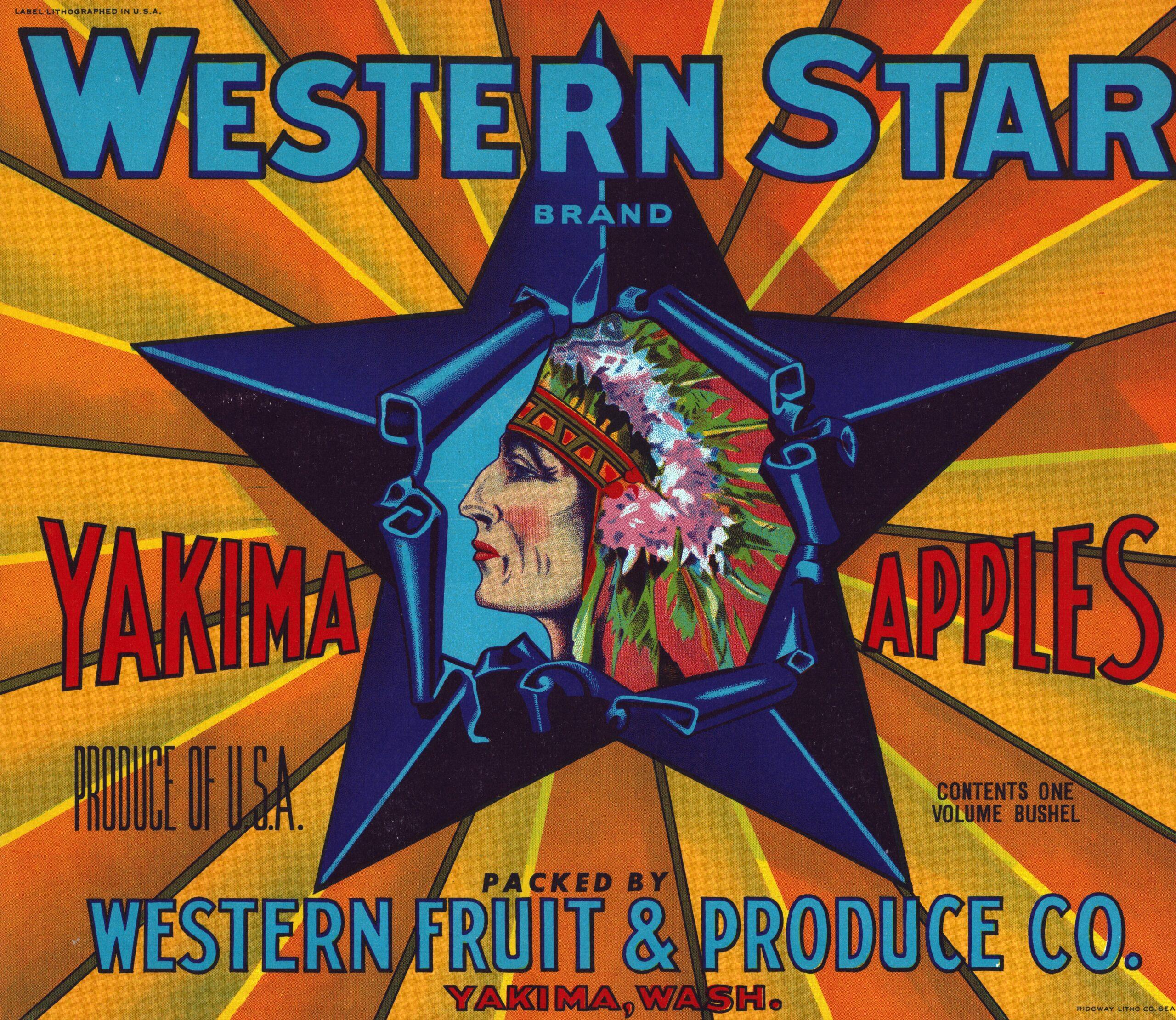
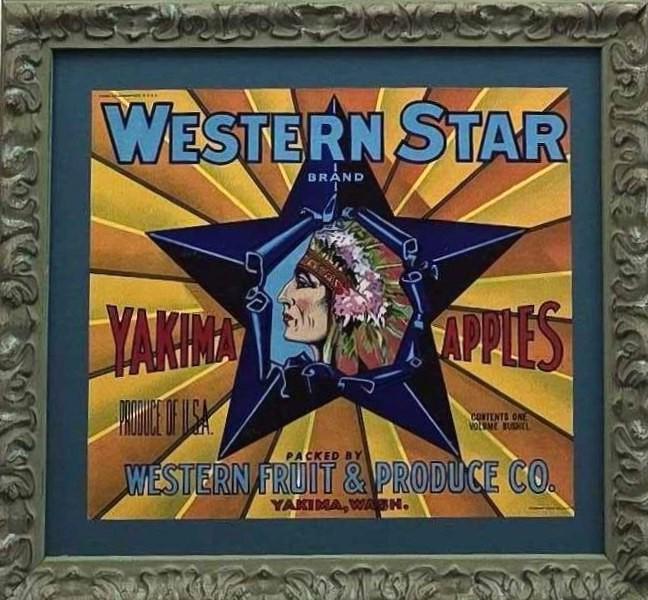
Western Star Yakima Apples Fruit Label C. 1928
The Western Star Yakima Apples label was produced primarily in the 1920s to 1940s, with documented examples dated to circa 1928 and extending into the 1940s, during the golden age of Washington’s apple crate labeling (roughly 1910–1950) before the industry’s shift to pre-printed cardboard boxes post-World War II.
The label’s Art Deco-influenced design, featuring ornate typography, geometric borders, and a stylized Native American chief in profile with headdress, aligns with lithographic printing trends from the interwar period, often produced by regional printers for Yakima packers. Archival records specify a 1928 example, while collector sales confirm 1930s–1940s prints showing minor wear from moisture exposure typical of that era’s storage. Uncertainties include variations in print runs (e.g., one-bushel vs. 40-pound crate sizes), but no evidence suggests production before 1920 or after the 1950s.
The label emerged amid Yakima Valley’s apple boom, starting with 1888 shipments to Eastern markets via rail, evolving into a major hub by the early 1900s with cooperatives like the 1903 Yakima County Horticultural Union—the state’s first tree fruit marketing group. It branded wooden crates to promote premium varieties (e.g., Red Delicious, Golden Delicious) shipped nationwide, helping Washington claim over 60% of U.S. apple production by the 1940s; Yakima alone shipped millions of boxes annually, transforming the arid valley into an orchard powerhouse through irrigation and cold storage innovations.
Incorporated around 1916 (paralleling similar firms like Washington Fruit), the company focused on growing, packing, and shipping apples, pears, and peaches from Yakima orchards. It contributed to the valley’s cooperative model, standardizing grades via label colors (e.g., background hues for quality) and facilitating rail exports during economic peaks like the Roaring Twenties.
The 1920s rail expansions boosted Yakima’s global reach, but the Great Depression and WWII rationing strained operations; post-1940s mechanization ended wooden crates. The Yakima Valley Museum began collecting labels in the 1970s as commercial use waned, preserving this era; annual swaps like the 2019 Fruit Label Swap Meet highlight ongoing interest.
Rooted in Yakima’s frontier heritage (Yakima Nation lands ceded in 1855, fueling white settlement and agriculture), the chief motif romanticizes Indigenous “noble savage” stereotypes to symbolize “natural purity” and Western wilderness, appealing to urban consumers craving authentic American bounty. It reflects broader 20th-century trends in advertising, where Native imagery conveyed superiority and exoticism amid Manifest Destiny echoes, often ignoring real cultural erasure; in Yakima, it ties to multicultural labor (e.g., Yakama, Latino, Japanese workers) in orchards.
These labels capture U.S. history’s complexities, featured in exhibits like the Smithsonian’s on Indigenous pop culture symbols; they spark discussions on appropriation vs. homage, influencing modern revivals in merchandise and art while underscoring Washington’s Yakima Nation heritage.
Western Fruit & Produce Co., based in Yakima, Washington, operated as a grower-packer from the early 1900s (formalized circa 1916), specializing in tree fruits. The Western Star Brand targeted apples in one-bushel (8.75 x 10-inch labels) or 40-pound crates, emphasizing high-grade, sun-ripened varieties for freshness; no specific key figures are prominently documented, but it aligned with family-run operations like those of Fred B. Plath in similar firms.
From Yakima facilities near rail lines, the company handled orchard harvesting, sorting, and crating for seasonal peaks (September–November), shipping via Northern Pacific Railroad to East Coast and international markets. It focused on quality branding to compete in a cooperative-dominated industry.
Affiliated with the Yakima Valley Growers-Shippers Association (est. 1917) and Washington State Horticultural Association for marketing and logistics; partnerships included rail carriers and co-ops like the 1903 Union. No major mergers noted for Western specifically, but parallels exist with Washington Fruit & Produce’s 2022 merger into Washington Fruit Sales; the brand’s legacy endures in archives, with no direct modern successors, though Yakima’s apple sector thrives via groups like the Washington State Tree Fruit Association (producing 134 million boxes in 2023).
-
-
Websites and Information Sites
-
Reviews
There are no reviews yet.